
Blog
Decentralized Wastewater Clusters: Designing Multiple Small Package Plants Across a Phased Development
One large regional plant is not always the right fit. See when multiple smaller package plants make more sense for a phased Texas development schedule now.
Quick Answer
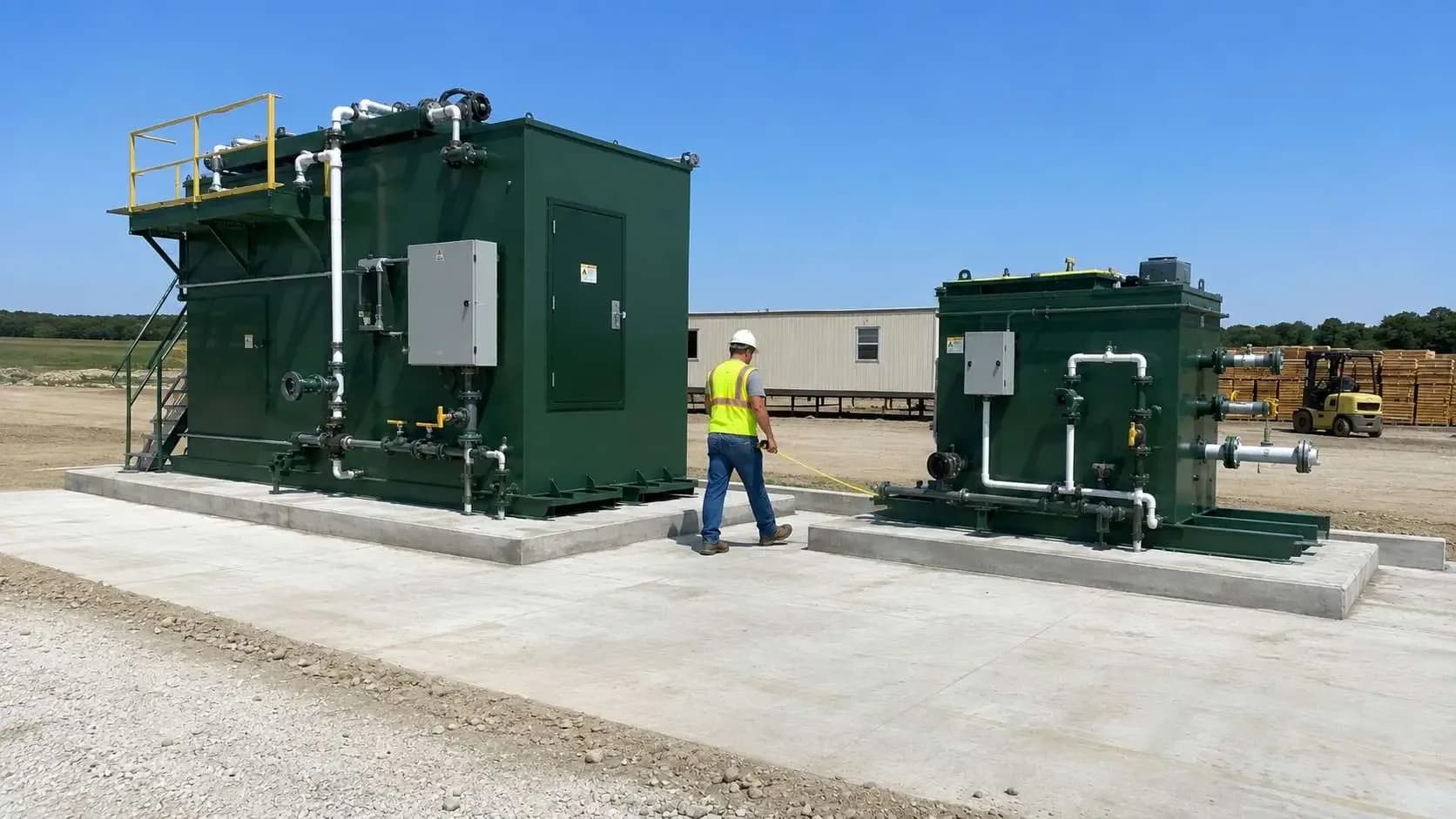
Centralized treatment, one large regional plant serving an entire development at full build out, is the default assumption for many developers planning wastewater infrastructure, but it is not always the best fit for every project. Large site acreage, phased construction spanning years, long sewer runs across difficult topography, delayed utility extensions, limited upfront capital, and genuine uncertainty about build out timing can all make a decentralized cluster strategy, multiple smaller package treatment plants sized and sited to match each phase, a more practical path forward. A cluster strategy lets early phases move forward on their own schedule without waiting on regional infrastructure that may be years away, but it comes with real tradeoffs in operator coordination, monitoring complexity, and long-term management that need to be weighed honestly against the flexibility it provides.
Why Centralized Treatment Isn’t Always the Right Default
A single large regional treatment plant makes strong sense when a development’s full extent and timeline are reasonably well understood from the start, when sewer runs from all phases to a central plant location are reasonably direct, and when the capital to build that centralized capacity upfront is available and justified by a confident build-out schedule. Many developments don’t actually meet all of these conditions. A large master-planned community phased over many years, with genuine uncertainty about how quickly later phases will actually develop, or a site where topography makes routing gravity sewer to a single central location impractical without extensive lift station and force main infrastructure, presents a materially different planning situation than the straightforward case centralized treatment fits well.
Large Site Acreage and Long Sewer Runs
A large site spanning significant acreage can make the collection system needed to route wastewater from distant phases to a single central treatment location a substantial infrastructure investment on its own, involving long sewer runs, multiple lift stations, and force mains that add both capital cost and ongoing operational complexity independent of the treatment plant itself. A decentralized cluster approach, siting smaller package plants closer to the phases they serve, can reduce this collection system burden considerably, since each package plant only needs to collect wastewater from its own nearby phase rather than conveying it across the entire site to a distant central location.
Phased Construction and Uncertain Build Out Timing
Where a development’s build out will occur over an extended period, and later phases’ timing is genuinely uncertain, sized and permitted centralized capacity built entirely upfront risks sitting underutilized for years if later phases develop more slowly than planned, representing capital committed well ahead of the actual need. A cluster strategy allows treatment capacity to be added incrementally, matched to actual development pace rather than a projected schedule that may or may not hold, reducing the risk of significant underutilized capacity sitting idle while still meeting each phase’s actual near-term treatment need as it comes online.
Difficult Topography
Site topography that would require extensive lift station and force main infrastructure to route wastewater to a single low point or central location can make decentralized treatment, positioning smaller plants to work with the site’s natural drainage patterns rather than against them, a more straightforward engineering approach. Evaluating actual site topography early, rather than assuming a centralized collection system will work regardless of terrain, helps identify whether a cluster strategy offers a genuine engineering advantage for a specific site’s conditions.
Delayed Utility Extensions and Limited Upfront Capital
Where connection to a regional utility system is the eventual long term goal, but that utility’s own infrastructure extension to reach the development’s location won’t be available for a significant period, a decentralized cluster strategy can provide interim service for early phases without waiting on infrastructure outside the developer’s control. Similarly, where upfront capital is more limited relative to the cost of building full centralized capacity immediately, a phased cluster approach allows treatment infrastructure investment to track alongside revenue and financing available as the development actually progresses, rather than requiring the full centralized investment before any phase can move forward.
Temporary Service Needs
Some phases within a larger development may have a genuinely temporary service need, an early phase intended to eventually connect to a regional utility or a later, larger centralized plant once that infrastructure becomes available, but requiring interim treatment capacity in the meantime. A package plant designed and permitted with this temporary role in mind, including a clear plan for eventual decommissioning or repurposing once permanent infrastructure comes online, addresses this specific situation more directly than treating every treatment installation as if it were intended to remain in permanent, standalone service indefinitely.
Design Flow by Phase
Sizing each package plant appropriately requires a clear projection of design flow for the specific phase it will serve, based on that phase’s anticipated unit count or commercial square footage and appropriate flow factors, rather than sizing based on a rough estimate or a plant size that happened to be readily available. Getting this phase-specific design flow projection right matters directly to whether each package plant in a cluster strategy actually performs adequately for its intended service area, neither undersized relative to actual demand nor unnecessarily oversized in a way that adds unnecessary capital cost without genuine benefit.
Package Plant Sizing and Redundancy
Package plants come in a range of capacities and configurations, and selecting the right size and configuration for each specific phase’s design flow, while also building in appropriate redundancy so a single equipment failure doesn’t take an entire phase’s treatment capacity offline, are both essential technical decisions. A cluster strategy with multiple smaller plants actually offers a potential redundancy advantage over a single large centralized plant in some respects, since a problem at one package plant in a cluster affects only that plant’s specific service area rather than the entire development, though this advantage depends on each individual plant still being properly designed with its own adequate redundancy rather than assuming the cluster’s plurality alone provides sufficient protection.
Operator Staffing
Multiple smaller package plants across a cluster generally require more total operator attention and coordination than a single centralized plant of equivalent overall capacity, since each plant needs its own routine monitoring, maintenance, and operational oversight regardless of its individual size. Planning for this operator staffing and coordination need realistically, rather than assuming a cluster strategy will somehow require less overall operator attention simply because individual plants are smaller, is an important part of evaluating the true long term operating cost and complexity of a decentralized approach compared to centralized treatment.
TCEQ Permitting for Multiple Plants
Each package plant in a cluster generally requires its own TCEQ wastewater permit, meaning a cluster strategy involves managing multiple permitting processes and, over the life of the development, multiple ongoing compliance and reporting obligations rather than a single consolidated permit covering the entire development. This permitting complexity is a genuine tradeoff against a cluster strategy’s phasing flexibility, and a developer should go into a cluster strategy with a realistic understanding of the cumulative permitting and compliance workload multiple separate plants create compared to one centralized facility.
Discharge Strategy, TLAP Feasibility, and 210E Reuse Potential
Each package plant’s discharge strategy, whether a direct surface water discharge requiring its own permit and receiving water evaluation, a land application permit approach if site conditions and soil characteristics support it, or Chapter 210 reclaimed water reuse potential if a suitable reuse application exists nearby, needs to be evaluated specifically for that plant’s service area and site conditions, since different phases within the same larger development may actually be better suited to different discharge strategies depending on their specific location and surrounding conditions. This phase by phase evaluation is itself one of the practical benefits of a cluster approach, allowing each plant’s discharge strategy to be optimized for its specific circumstances rather than forcing every phase into a single discharge approach chosen for the development as a whole.
Collection System Layout, Lift Stations, and Force Mains
Even within a decentralized cluster strategy, each individual package plant’s service area still needs its own properly designed collection system, and depending on that specific area’s topography, may still require lift stations and force mains to convey wastewater to that particular plant, even though the overall distances involved are typically shorter than would be needed to reach a single centralized location. Designing each cluster’s collection system specifically for its own service area’s conditions, rather than assuming decentralization automatically eliminates the need for lift stations entirely, keeps expectations realistic about what a cluster strategy actually simplifies and what it doesn’t.
Site Access, Odor Control, and Maintenance
Multiple package plants across a development site each need adequate access for operator visits, maintenance, and eventual equipment servicing, and each needs appropriate odor control given its proximity to whatever surrounding development, residential, commercial, or otherwise, exists near that specific plant location. Siting decisions for each package plant should account for these access and odor considerations specifically for that plant’s location, recognizing that a location convenient for construction staging during an early development phase may not remain an ideal long-term treatment plant location once surrounding development is complete.
Long Term Ownership
A cluster strategy raises its own long term ownership question distinct from a single centralized plant: will each package plant ultimately be owned and operated by the developer indefinitely, transferred to a utility district or municipality at some point, or eventually decommissioned once regional utility connection becomes available. Clarifying this long term ownership path for each plant in the cluster, ideally during initial planning rather than left undecided until a transition actually becomes necessary, helps avoid the kind of ownership and responsibility ambiguity that can create complications during an eventual transition, similar to the risks discussed for permit transfers generally.
Weighing the Tradeoffs Honestly
A decentralized cluster strategy offers genuine advantages for the right development, reduced early infrastructure burden, capacity that scales with actual build out pace, flexibility to match discharge strategy to each phase’s specific conditions, and a form of built in redundancy across the cluster. It also carries genuine costs, more operator coordination, more monitoring points and reporting obligations, more permitting complexity, and a more involved long term management picture than a single centralized facility. Evaluating both sides honestly for a specific development’s actual site conditions, capital position, and build out uncertainty, rather than defaulting to either centralized or decentralized treatment based on general preference, produces the wastewater strategy genuinely best matched to that specific project.
Frequently Asked Questions
Can a cluster of package plants eventually be consolidated into one centralized plant as a development builds out?
This is possible and worth planning for from the start if it’s a likely eventual direction, since anticipating this transition during initial cluster design, site selection, and permitting can make an eventual consolidation considerably smoother than treating each package plant as a permanent, standalone installation with no future transition planned.
Does a cluster strategy always cost less than centralized treatment?
Not necessarily in total long-term cost, since a cluster strategy typically reduces upfront capital burden and collection system cost but can increase ongoing operator staffing, monitoring, and permitting costs over the long run, meaning the actual cost comparison depends on the specific project and should be evaluated over the development’s full anticipated timeline, not just the initial capital outlay.
How do we decide which discharge strategy is right for each individual plant in a cluster?
Each plant’s discharge strategy should be evaluated specifically against its own service area’s site conditions, receiving water availability, soil characteristics for land application, and any nearby reuse application potential, rather than assuming every plant in the cluster should use the same discharge approach.
Is a decentralized cluster strategy realistic for a smaller phased development, or only for very large master-planned communities?
Cluster strategies can suit developments of varying scale, though the specific factors favoring decentralization, large acreage, difficult topography, long build-out timelines, should be evaluated for the specific development in question rather than assuming scale alone determines whether this approach makes sense.
Related Resources
- Land Application Permits in Texas: A Faster Path to Wastewater Approval for Developers
- TPDES Permit Transfer During a Property Sale: What Happens to an Active Discharge Permit When a Developer Sells a Partially Built Project
- Outfall Design and Diffuser Engineering: The Overlooked Civil Design Work Behind a Compliant Discharge Point
- Combined Sewer vs. Separate Sanitary Systems in Older Texas Cities: Why Legacy Infrastructure Changes a Discharge Permit’s Monitoring Burden
Evaluating Centralized Versus Decentralized Wastewater Strategy for a Phased Development?
MES helps developers compare centralized and decentralized treatment strategies, size package plants by phase, evaluate TCEQ permitting options, and design practical wastewater systems that match the development schedule.
We specialize in:
- Centralized versus decentralized wastewater strategy comparison based on site conditions and build-out timing
- Design flow projection and package plant sizing matched to individual development phases
- TCEQ permitting strategy across single or multiple treatment plant installations
- Discharge strategy evaluation, including direct discharge, land application, and Chapter 210 reuse potential
- Collection system, lift station, and force main design for cluster and centralized approaches alike
- Long term ownership and eventual consolidation or utility transition planning for package plant clusters
Modern Engineering Solutions, McKinney, Texas. Contact: (214) 833-6748 or mod-eng.com
Keep reading
More to read.
Talk to an engineer
Tell us about your project.
An engineer reads it
Not a salesperson. Someone who can tell you whether the pathway is real.
You get a first answer
Your options, the agencies involved and the questions that decide cost and schedule.
You decide
No commitment to have the first call.
Prefer the phone? (214) 833-6748