
Blog
Erosion and Sedimentation Control at the Discharge Point: What Inspectors Check When Test Water Hits Open Ground
Learn how discharge point erosion controls protect clean hydrostatic test water from sediment, turbidity, storm drain complaints, and inspections.
Quick Answer
Clean, properly dechlorinated hydrostatic test water can still cause a compliance problem if the way it leaves the pipe, hose, tank, or pump erodes the ground it lands on. A high volume discharge onto bare soil, even water that passed every water-quality check, can carve a channel, mobilize sediment, and send muddy runoff toward a storm drain or creek fast enough to draw a complaint or fail an inspection. Inspectors checking a discharge point aren’t just verifying water quality. They’re checking discharge velocity, whether flow is spread out or concentrated, whether the ground is stabilized, and whether erosion controls were in place before discharge started, not added afterward once erosion was already visible.
Why the Water Being Clean Isn’t the Whole Story
A project team that properly dechlorinates test water, confirms residual chlorine and pH are within acceptable limits, and picks a discharge location outside a sensitive receiving water can still end up with a visible compliance problem if that same water is released at high velocity directly onto unstabilized soil. Water quality and erosion control are two separate issues addressing two separate risks, and passing on water quality does nothing to protect against the physical force of a concentrated discharge stream cutting into bare ground, mobilizing sediment, and carrying it toward whatever drainage path is nearby.
This is the gap that turns an otherwise compliant water quality plan into a visible erosion violation: the water itself was fine, but nobody planned for what happens physically at the point where it hits the ground.
What Discharge Velocity and Flow Spreading Actually Determine
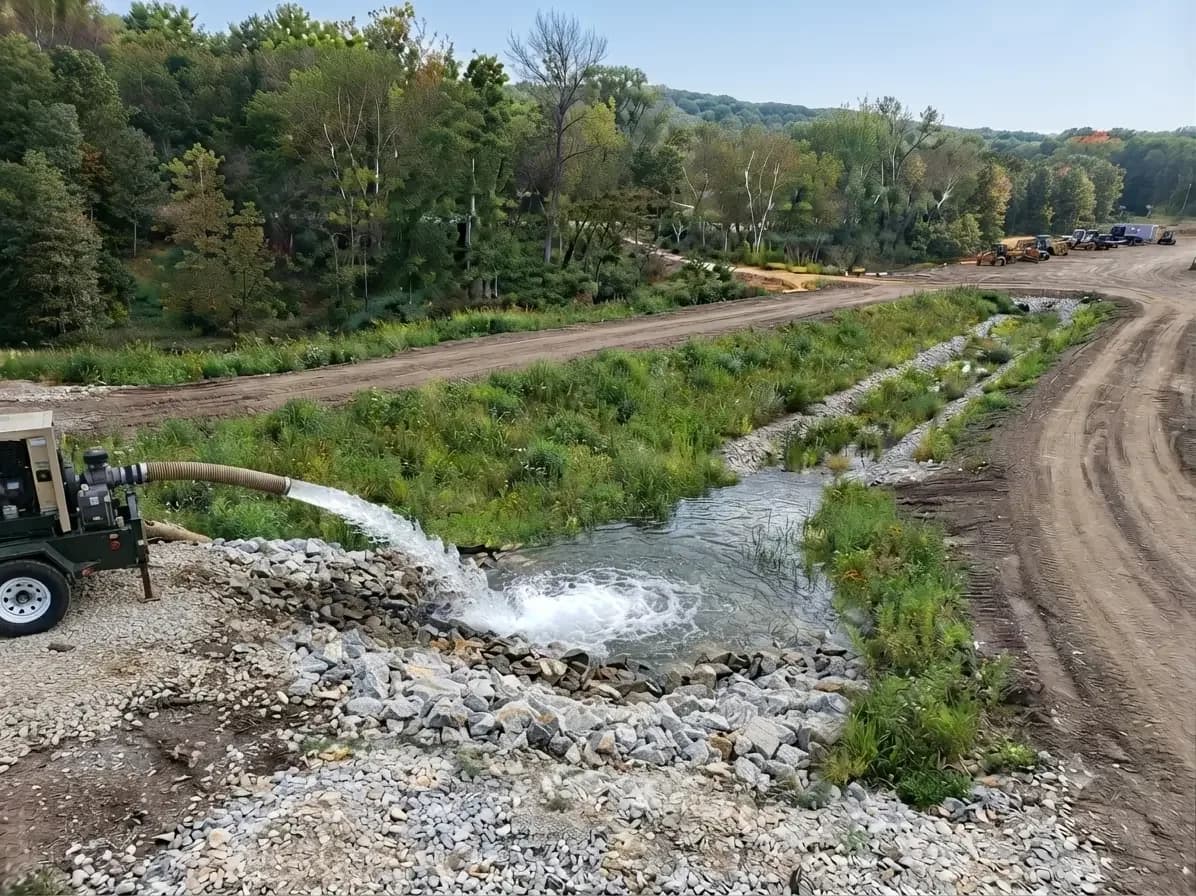
Discharge velocity, how fast and how forcefully water exits a pipe, hose, or pump discharge point, directly determines how much erosive energy is delivered to the ground at that location. A high velocity discharge concentrated into a small area delivers considerably more erosive force than the same total volume spread out and slowed down before it reaches unstabilized soil. This is why flow spreading, using a diffuser, a spreader plate, or simply directing discharge across a wider stabilized area rather than a single concentrated point, is one of the most basic and most frequently skipped erosion control measures on a hydrostatic test water or dewatering discharge.
A crew focused on completing a discharge efficiently often defaults to the simplest setup, a hose or pipe pointed at the nearest open ground, without evaluating whether that setup’s velocity and concentration will erode the receiving surface. Inspectors checking a discharge point evaluate exactly this: is the water arriving in a way the ground can absorb, or in a way that’s actively eroding it.
Stabilized Outlets, Riprap Pads, and Energy Dissipation
A stabilized outlet, whether a riprap pad, a constructed energy dissipation structure, or another engineered feature designed to slow and spread discharge flow before it reaches unprotected ground, is the standard solution for managing discharge velocity at a fixed discharge point. Riprap pads work by breaking up concentrated flow into turbulence across a rock surface, which reduces velocity and spreads the discharge before it reaches soil, meaningfully reducing erosive potential compared to discharge directly onto bare or vegetated ground with no energy dissipation feature at all.
Installing a stabilized outlet before discharge begins, not after erosion has already started, is the detail inspectors specifically look for, since a stabilized outlet added reactively after visible erosion has occurred demonstrates exactly the planning gap that created the problem in the first place.
Filter Bags, Sediment Basins, and Check Dams
Where discharge water carries any sediment, even sediment within acceptable water quality parameters for the discharge itself, additional controls between the discharge point and any downstream drainage path can prevent that sediment from traveling further than necessary. Filter bags placed at a discharge point capture sediment as water passes through, reducing the sediment load reaching the ground or downstream conveyance beyond the immediate discharge area. Sediment basins, where site conditions allow for one, provide a larger scale settling area for sediment to drop out of suspension before water continues downstream. Check dams placed along a flow path downstream of the discharge point slow flow velocity at intervals, giving sediment additional opportunity to settle before reaching a receiving water or storm drain.
Which combination of these controls is appropriate depends on discharge volume, duration, and the specific flow path between the discharge point and any sensitive downstream feature, an evaluation that should happen during discharge planning, not improvised in the field once discharge has already started and a problem becomes visible.
Erosion Blankets and Vegetated Buffers
For discharge flow paths crossing open or recently disturbed ground before reaching a stabilized area or drainage feature, erosion blankets can provide temporary surface protection, holding soil in place against flow while also supporting any vegetation establishment intended for that area longer term. Vegetated buffers, where established vegetation already exists along a flow path, provide a similar function by absorbing flow energy and filtering sediment through root structure and ground cover, generally performing this function considerably better than bare soil would.
Evaluating the condition of ground along the entire anticipated flow path, not just the specific discharge point itself, matters because a well controlled discharge point can still create a problem further downstream if the flow path beyond it crosses unstabilized ground with no additional protection.
Turbidity as the Visible Symptom Inspectors Notice First
Turbidity, the cloudiness of water caused by suspended sediment, is often the first visible indicator an inspector, a downstream property owner, or anyone else observing a discharge notices, and elevated turbidity in what should be relatively clean discharge water is a strong signal that erosion is actively occurring somewhere along the discharge and flow path. A discharge that starts clear but becomes visibly turbid as it crosses bare soil is showing, in real time, exactly the erosion process an inspector is trained to look for, which is why controlling erosion at and downstream of the discharge point directly protects against a turbidity based compliance concern, independent of whatever the original discharge water quality actually was.
Receiving Drainage Paths and Where the Water Actually Goes
Understanding the complete drainage path a discharge will follow, from the discharge point itself to wherever that flow ultimately reaches a storm drain, ditch, or receiving water, is necessary to properly plan erosion controls, since a control installed only at the immediate discharge point does nothing to address erosion or sediment transport occurring further along that path. Walking the anticipated flow path before discharge begins, identifying any unstabilized sections, any grade changes that could concentrate flow, and any point where the flow path narrows or steepens, allows erosion controls to be placed where they’re actually needed rather than only at the most obvious location.
Whether Controls Are Installed Before Discharge Begins
This is the single detail that separates a well managed discharge from a compliance risk: were erosion and sediment controls in place and functioning before discharge started, or were they added reactively once erosion, sediment transport, or a downstream complaint had already occurred. Inspectors evaluating a discharge point are specifically looking for evidence of proactive planning, controls installed and appropriately sized for the anticipated discharge before the first gallon of water was released, rather than evidence of a reactive scramble to address a problem that had already become visible.
Frequently Asked Questions
If our test water passed all water quality checks, do we still need erosion controls at the discharge point?
Yes. Water quality and erosion control address two separate risks, and clean water discharged at high velocity onto unstabilized ground can still cause visible erosion and sediment transport regardless of how well that water performed on chlorine, pH, or sediment testing.
How do we determine the right combination of erosion controls for a specific discharge point?
This depends on anticipated discharge volume, duration, ground conditions at and downstream of the discharge point, and the complete flow path to any drainage feature, an evaluation that should happen during discharge planning by walking the actual flow path rather than defaulting to a generic control setup regardless of site specific conditions.
What is the most common erosion control mistake on hydrostatic test water discharges?
Discharging directly onto bare soil through a hose or pipe with no energy dissipation or flow spreading, relying on the assumption that because the water itself is clean or was properly treated, the discharge point doesn’t need additional protection.
Can erosion controls be added after discharge has already started if a problem becomes visible?
Reactive controls can limit further damage once a problem is noticed, but they don’t undo erosion or sediment transport that has already occurred, and inspectors specifically look for evidence that controls were planned and installed proactively rather than added only after a visible problem prompted a response.
Related Resources
- Discharging to a Storm Drain vs. Sanitary Sewer: Why Texas Contractors Get It Wrong on Pipeline and Tank Projects
- Chlorine Neutralization Before Discharge: The Field Step Contractors Skip Until It Becomes a Compliance Problem
- TPDES General Permit vs. Individual Permit for Construction Discharges: When the Standard Permit Is Not Enough
- Land Application Permits in Texas: A Faster Path to Wastewater Approval for Developers
Planning Discharge Points for an Upcoming Testing or Construction Phase?
MES helps contractors and developers plan discharge points, stabilize flow paths, select appropriate erosion controls, and reduce inspection risk during hydrostatic testing and construction discharges.
We specialize in:
- Discharge point design including flow spreading, energy dissipation, and stabilized outlet detailing
- Sediment control selection including filter bags, sediment basins, and check dams matched to site conditions
- Flow path evaluation from discharge point to receiving drainage feature
- Erosion blanket and vegetated buffer planning for disturbed or open ground along discharge paths
- Turbidity monitoring guidance to catch erosion issues before they become inspection findings
- Proactive erosion control planning integrated into testing and construction discharge scheduling
Modern Engineering Solutions, McKinney, Texas. Contact: (214) 833-6748 or mod-eng.com
Keep reading
More to read.
Talk to an engineer
Tell us about your project.
An engineer reads it
Not a salesperson. Someone who can tell you whether the pathway is real.
You get a first answer
Your options, the agencies involved and the questions that decide cost and schedule.
You decide
No commitment to have the first call.
Prefer the phone? (214) 833-6748