
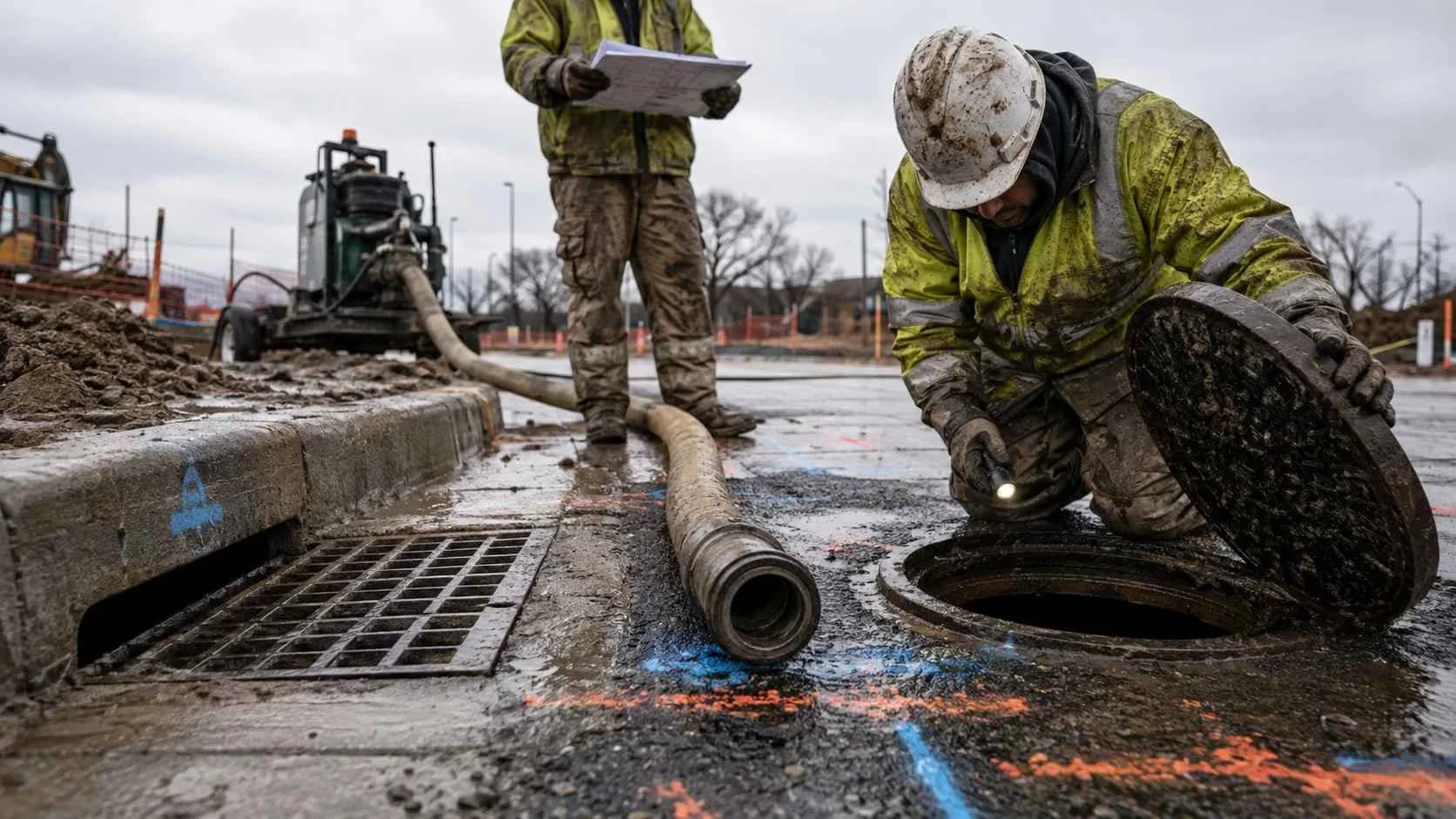
Blog
Discharging to a Storm Drain vs. Sanitary Sewer: Why Texas Contractors Get It Wrong on Pipeline and Tank Projects
Discharging test water into the wrong system without confirming which drain it connects to is one of the most common field mistakes on Texas pipeline projects.
Quick Answer
A storm drain and a sanitary sewer look similar from the surface, both are just an inlet, a manhole, or a pipe in the ground, but they serve entirely different systems with entirely different regulatory implications. Storm drains typically convey stormwater directly to a creek, ditch, or other receiving water with no treatment in between. Sanitary sewers convey wastewater to a treatment plant, where it receives treatment before discharge. Discharging construction water, hydrostatic test water, or tank water into the wrong one of these systems, without confirming which system it actually is and without the correct permission for that specific system, is a common and entirely avoidable field mistake that can trigger a violation, damage to the receiving system, or a costly correction after the fact.
Why This Mistake Happens
On an active construction site, a nearby inlet, manhole, or ditch is often the most convenient discharge point available, and a crew focused on completing dewatering or test water release efficiently can treat any of these openings as functionally interchangeable, an assumption that any drain is an acceptable discharge point simply because it’s nearby and appears to be part of the site’s drainage infrastructure. That assumption ignores the fact that a storm drain inlet and a sanitary sewer manhole connect to two completely separate systems, each governed by its own set of rules about what can be discharged into it, and confirming which system a specific opening actually connects to is a necessary step before any discharge occurs there, not an assumption to make based on appearance or location.
How Storm Drains and Sanitary Sewers Actually Differ
A storm drain system is designed to convey stormwater runoff, generally untreated, from streets, parking lots, and other surfaces to a receiving water body such as a creek, retention pond, or larger drainage channel. Because this water typically reaches a natural water body without treatment, storm drain discharge compliance is directly tied to the quality of whatever water enters that system, since anything discharged into a storm drain is effectively being discharged to the receiving water itself, just with a delay and some conveyance distance in between.
A sanitary sewer system, by contrast, conveys wastewater to a publicly owned treatment works, a POTW, where it undergoes treatment before any discharge to a receiving water. This treatment step means a sanitary sewer can generally accept water with characteristics that would be inappropriate for direct storm drain discharge, but it introduces a different constraint: the POTW has its own capacity, treatment process considerations, and approval requirements governing what can be discharged into its system, since an unexpected volume or an unexpected pollutant load can affect the treatment plant’s ability to function properly for its intended purpose.
Storm Drain Outfalls and What Happens Downstream
Understanding where a storm drain system’s outfall actually discharges, and how quickly water introduced at a given inlet reaches that outfall and the receiving water beyond it, helps clarify why storm drain discharge compliance is treated so directly in proportion to water quality. Sediment laden water, chlorinated water, or water carrying other pollutants introduced into a storm drain inlet has a short and largely untreated path to a receiving water, meaning any quality issue in that discharge becomes a quality issue in the creek or channel the storm system empties into, generally within a short time frame. This is why storm drain discharge decisions require the same water quality evaluation, residual chlorine, sediment, pH, discussed for any direct discharge to a receiving water.
Sanitary Sewer Capacity and POTW Approval
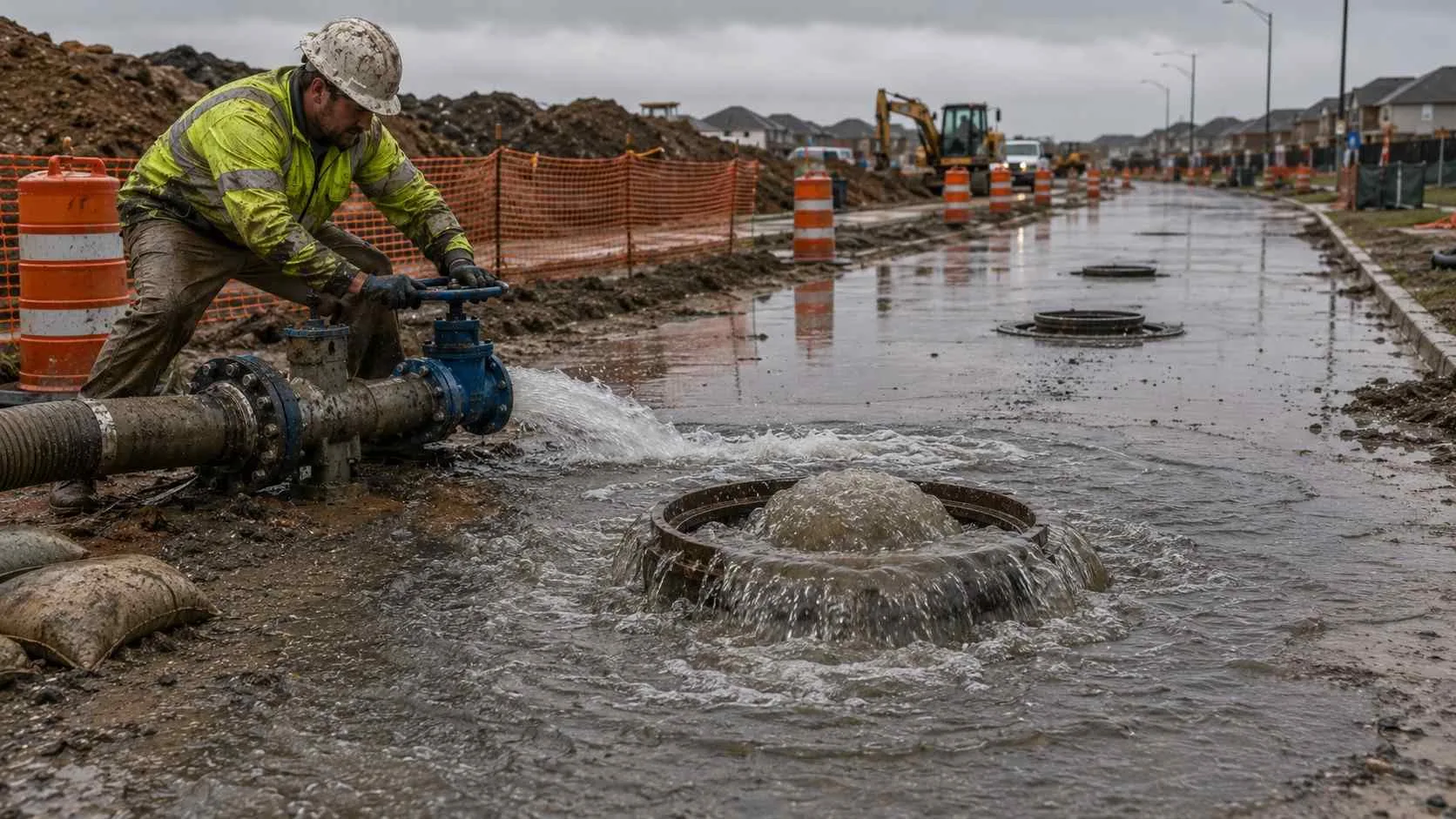
Discharging construction water, test water, or tank water to a sanitary sewer requires a different kind of evaluation, centered on whether the receiving treatment plant has the capacity and the appropriate approval process to accept that specific discharge. A large volume of hydrostatic test water discharged into a sanitary sewer without prior coordination can affect that sewer segment’s hydraulic capacity, potentially causing surcharging or backup issues in the collection system upstream of the treatment plant, entirely separate from any water quality consideration. POTW approval for accepting construction related discharges typically involves confirming the anticipated volume, discharge rate, and any pollutant characteristics with the utility operating the sanitary sewer system, since the utility needs to evaluate whether its system and treatment process can accommodate that specific discharge without disruption.
Assuming that because a sanitary sewer offers treatment downstream, any discharge is automatically acceptable there without confirming capacity and approval, is its own version of the same underlying mistake, treating a system as generically available without confirming its actual constraints.
Chlorine Residual, Sediment, and pH Considerations by System
Water quality parameters that matter for a storm drain discharge, because that water is heading largely untreated to a receiving water, carry different weight for a sanitary sewer discharge, where treatment downstream can address some but not all of these same characteristics. Chlorine residual, for example, that would create direct aquatic toxicity concern in a storm drain discharge to a creek, is generally handled differently by a treatment plant designed to process chlorinated wastewater as part of its normal operation, though this doesn’t mean chlorine residual is irrelevant in a sanitary sewer discharge, since concentration and volume still matter to the treatment process itself. Sediment loading has similar differentiated implications: a storm drain discharge with elevated sediment reaches a receiving water largely as is, while a sanitary sewer discharge with elevated sediment can create issues within the collection system itself, contributing to blockages or maintenance issues in sewer lines not designed to convey significant sediment load.
pH considerations follow this same pattern: relevant to both systems, but with different tolerance and different downstream consequence depending on whether the receiving system is a storm drain heading to a creek or a sanitary sewer heading to a treatment plant designed to buffer some degree of pH variability.
Flow Rate and Bypass Risk
Discharge rate matters differently for each system as well. A high flow rate discharged too quickly into a storm drain can create erosion and scour issues at the discharge point and along the downstream conveyance path. A high flow rate discharged into a sanitary sewer carries a different risk, potentially exceeding that sewer segment’s hydraulic capacity and causing a bypass or backup condition, where wastewater that cannot be conveyed normally through the system finds an alternate and unauthorized path, a scenario with its own significant regulatory and environmental implications distinct from a storm drain erosion issue. Confirming an acceptable discharge rate for the specific system and specific location involved, rather than assuming a single discharge rate is appropriate regardless of which system receives it, is a necessary part of planning any construction-related discharge.
Local Utility Permission and Documentation
Whether discharging to a storm drain or a sanitary sewer, confirming permission from the utility or municipality operating that specific system, and documenting that permission along with the discharge’s actual characteristics and volume, protects a contractor or developer if a question arises later about whether the discharge was properly authorized. This permission process differs by system and by jurisdiction, and a contractor accustomed to one utility’s process for sanitary sewer discharge approval shouldn’t assume an identical process applies with a different utility or a different system on a different project, since local requirements and approval procedures vary.
The Cost of Correcting an Improper Discharge
Discovering after the fact that a discharge went into the wrong system, whether stormwater intended for a storm drain accidentally reached a sanitary sewer, or a discharge requiring treatment ended up in a storm drain without proper evaluation, creates a correction problem considerably more disruptive than the original planning step would have been. Correcting an improper discharge can involve reporting obligations, remediation of any impact on the receiving system or water body, and in more serious cases, enforcement action, none of which compares favorably to the modest time investment of confirming the correct system and obtaining proper permission before the discharge occurred in the first place.
Frequently Asked Questions
How do we confirm whether a specific inlet or manhole on our site connects to a storm drain or a sanitary sewer?
This requires reviewing as-built utility drawings for the site and, where uncertainty remains, confirming directly with the local utility or municipality, since visual appearance alone does not reliably distinguish between the two systems and assuming based on appearance is exactly the mistake that leads to improper discharges.
Is sanitary sewer discharge always the safer option since the water gets treated before reaching a receiving water?
No. Sanitary sewer discharge introduces its own constraints around collection system capacity, treatment plant approval, and potential surcharging or bypass risk if volume or rate exceeds what the system can handle, so it isn’t automatically the lower risk choice without confirming capacity and obtaining proper approval first.
Do we need separate permission for storm drain discharge and sanitary sewer discharge, or does one approval cover both?
These require separate permission processes tied to the specific system and the specific utility or municipality operating it, since a storm drain discharge and a sanitary sewer discharge are governed by different regulatory considerations and typically different local approval processes.
What is the most common version of this mistake on pipeline and tank projects specifically?
Discharging hydrostatic test water or tank dewatering water into whichever nearby inlet or manhole is most convenient without confirming which system it connects to, an assumption that becomes especially risky when the water carries chlorine residual, sediment, or other characteristics requiring evaluation specific to the receiving system.
Related Resources
- Chlorine Neutralization Before Discharge: The Field Step Contractors Skip Until It Becomes a Compliance Problem
- TPDES General Permit vs. Individual Permit for Construction Discharges: When the Standard Permit Is Not Enough
- Land Application Permits in Texas: A Faster Path to Wastewater Approval for Developers
- Coastal Water Authority Raw Water Contracts: What Industrial Users in the Houston Ship Channel Need to Know
Confirming the Correct Discharge Pathway for Your Pipeline or Tank Project?
MES helps contractors, developers, and utility teams identify the correct discharge pathway, coordinate with local storm and sanitary utilities, avoid cross-system mistakes, and prevent unnecessary compliance risk during construction.
We specialize in:
- Confirming storm drain versus sanitary sewer connections through as-built review and utility coordination
- Water quality evaluation specific to each discharge pathway’s regulatory requirements
- POTW capacity and approval coordination for sanitary sewer discharge requests
- Discharge rate and bypass risk evaluation for high volume construction and test water releases
- Local utility permission documentation to support a defensible compliance record
- Discharge planning integrated into overall construction sequencing for pipeline, tank, and utility projects
Modern Engineering Solutions, McKinney, Texas. Contact: (214) 833-6748 or mod-eng.com
Keep reading
More to read.
Talk to an engineer
Tell us about your project.
An engineer reads it
Not a salesperson. Someone who can tell you whether the pathway is real.
You get a first answer
Your options, the agencies involved and the questions that decide cost and schedule.
You decide
No commitment to have the first call.
Prefer the phone? (214) 833-6748