
Blog
Landowner Liability When Discharge Crosses Property Lines: What Happens When Test Water Leaves the Site
A discharge can pass every water quality test and still cross a property line, damaging neighboring land and creating serious liability for the project.
Quick Answer
A contractor can neutralize the chlorine, confirm the pH, control the discharge rate, and still end up with a liability problem if that same properly treated water crosses onto a neighboring parcel, enters a private pond, causes erosion on someone else’s land, or triggers a nuisance complaint. Water quality compliance and property boundary compliance are two different questions, and passing the first one doesn’t protect against failing the second. “Clean water” is not a defense if it left the authorized discharge area and caused damage or a complaint on land the project had no right to affect. Mapping the discharge path before testing begins, not just the discharge point itself, is what actually prevents this kind of avoidable liability.
Why “The Water Was Clean” Isn’t the Whole Answer
A contractor who properly dechlorinated test water, confirmed pH, and controlled discharge rate has done real compliance work, and it’s understandable to feel like the job is finished once those water quality steps check out. But water quality compliance answers the question of whether the discharge itself was safe. It doesn’t answer a separate question: where did that water actually go, and did it stay within the area the project had authorization to affect. A discharge that meets every water quality parameter can still cross a property line, reach a neighboring parcel’s soil, pond, or drainage feature, and create a real problem for the project even though the water itself was never the issue.
This is the gap that catches contractors focused entirely on water quality compliance: the discharge point was chosen, the water was treated, but nobody traced where the water would physically travel once it left that point, and it traveled further, and onto different land, than anyone anticipated.
Discharge Path Mapping Beyond the Discharge Point
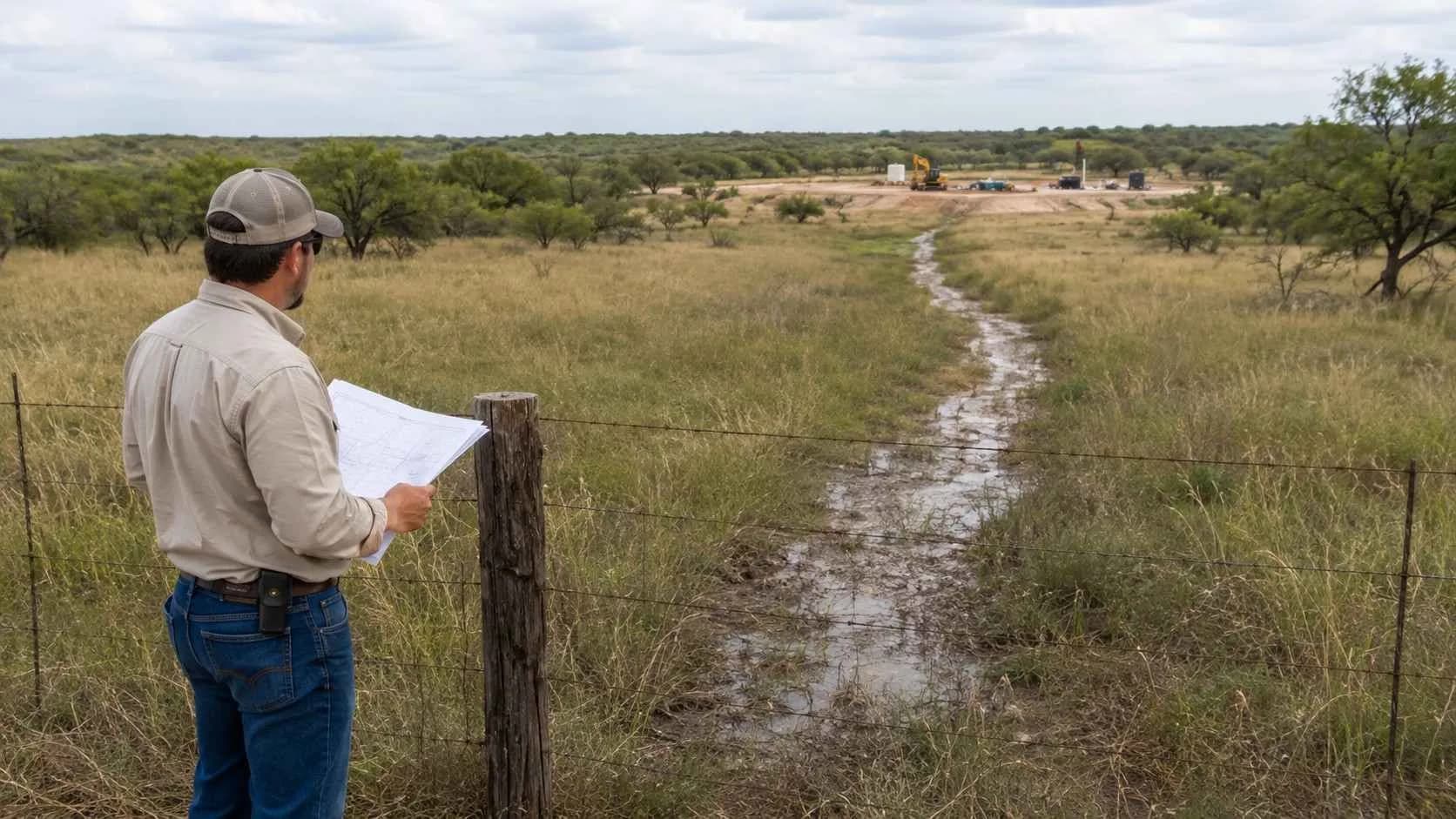
Planning a discharge point is only the first half of the job. The second half is understanding the complete discharge path, where water actually flows once it leaves that point, across what grade, through what vegetation or drainage feature, and ultimately onto whose land, before it reaches wherever it’s supposed to end up. A discharge point located on the project site can still send water flowing across a property line within a short distance if the grade slopes that direction, and this is exactly the kind of detail that a discharge plan focused only on the immediate discharge point, without walking and mapping the actual downstream flow path, can miss entirely.
Mapping this path before testing begins, using site topography and, where necessary, a field walk of the actual anticipated flow route, identifies where property boundaries intersect the discharge path and where additional controls or notification might be needed before discharge ever occurs.
Property Boundaries and Easements
Confirming exact property boundaries relative to the discharge point and anticipated flow path, rather than relying on a general sense of where the site ends, protects against an avoidable mistake, especially on sites where boundary lines aren’t obviously marked in the field or where a construction easement covers only a specific corridor rather than the full extent of land the discharge might actually reach. An easement authorizing construction activity within a defined corridor doesn’t necessarily authorize a discharge that travels beyond that corridor’s boundaries, and confirming what the easement or other site access agreement actually covers, relative to where discharge water will travel, is a detail worth checking specifically rather than assuming general construction access covers any resulting discharge path.
Downstream Flow Routes and Where Water Actually Ends Up
Beyond the immediate area around a discharge point, water continues to flow somewhere, whether toward a ditch, a low area, a pond, or another feature further from the site than the discharge point itself. Tracing this full downstream route, not just the first few feet from the discharge point, is what reveals whether a discharge that looks contained near its source will actually stay contained by the time it travels its full path. A downstream route crossing onto a neighboring parcel before reaching its ultimate destination creates the property line crossing at the center of this liability concern, even if the discharge point itself was located well within the project’s own boundaries.
Erosion Damage and Nuisance Complaints on Neighboring Land
Where discharge water crosses onto a neighboring parcel, the resulting damage or disruption can take several forms: erosion cutting into the neighboring landowner’s soil, sediment deposition affecting their land’s condition or appearance, water entering a private pond or feature in a way the owner didn’t expect or consent to, or simply a nuisance complaint from a landowner who noticed unexpected water, mud, or disruption originating from a neighboring construction project. Any of these outcomes creates a real problem for the project team responsible for the discharge, independent of whether the water itself met every water quality parameter, because the underlying issue isn’t water quality, it’s the unauthorized presence of that water on land the project had no right to affect.
Neighbor Notification Before Discharge Begins
Where a discharge path analysis reveals any realistic possibility of water reaching a neighboring parcel, even briefly or in a controlled way, proactive neighbor notification before discharge begins is a practical step that can prevent a surprised landowner’s reaction from escalating into a formal complaint. A landowner who was told in advance that a controlled, temporary discharge might briefly affect a specific area of their property, and given a chance to raise any concern before it happened, generally responds very differently than a landowner who discovers unexpected water or erosion on their land with no prior warning and no explanation. This notification step costs little and can meaningfully reduce the likelihood of an adversarial response.
Local Drainage Rules and Contractor Responsibility
Local drainage rules, whether from a municipality, a county, or another local authority, may impose their own requirements around discharge crossing property lines or affecting drainage patterns beyond a project’s own boundary, independent of state level discharge permitting. Confirming these local rules as part of overall discharge planning, alongside the property boundary and flow path mapping already discussed, rounds out a complete picture of what’s actually required before discharge crosses beyond the immediate project site. Responsibility for managing this risk generally sits with whoever controls the discharge activity in the field, meaning the contractor executing the discharge needs to understand and act on this planning, not simply assume it was someone else’s job to have already addressed before the crew arrived on site.
Owner Risk Versus Contractor Risk
While a contractor executing a discharge carries direct field responsibility for how that discharge is managed, the project owner or developer typically carries a related but distinct exposure if a neighboring landowner pursues a complaint or claim related to discharge crossing property lines, since the owner’s project ultimately created the circumstances leading to that discharge regardless of which specific party physically operated the valve. This shared exposure is part of why discharge path planning benefits from coordination between the owner, the contractor, and the engineer responsible for discharge planning, rather than being treated as solely a field level contractor decision made without owner or engineering input into where the discharge might actually travel.
Documentation as Protection After the Fact
If a discharge does end up crossing a property line, whether due to an unanticipated flow path, an unusually heavy rainfall combining with discharge flow, or another unexpected factor, documentation showing the discharge planning that was done in advance, water quality testing results, discharge path mapping, and any neighbor notification that occurred, provides a considerably stronger position for the project team than having no record of any proactive planning at all. This documentation doesn’t eliminate the underlying problem if damage occurred, but it demonstrates that the project team took reasonable steps to plan and control the discharge, which matters if a dispute over responsibility for the resulting damage arises.
Frequently Asked Questions
If our discharge point is clearly within our own property, do we still need to worry about property line crossing?
Yes. The discharge point being within the project’s own boundary doesn’t guarantee the water stays there, since grade and flow path determine where discharged water actually travels after release, and a discharge point well within the site can still send water across a property line a short distance downstream if the flow path leads that direction.
Should we always notify neighboring landowners before any discharge, even a small one?
This depends on whether discharge path mapping shows any realistic likelihood of that discharge affecting neighboring land, and for discharges with no plausible path toward a property boundary, notification may not be necessary, but where any realistic possibility exists, proactive notification is a low-cost step that can prevent a much larger problem.
Who is responsible if test water crosses a property line and causes damage, the contractor or the project owner?
Responsibility can be shared or allocated differently depending on the specific project agreements, contracts, and circumstances involved, and this is a legal question that should be directed to the project’s attorney rather than assumed based on general practice, since contract terms and specific facts significantly affect how responsibility is actually allocated.
Does having a valid discharge permit protect us if water crosses a property line?
A discharge permit addresses water quality and volume compliance with environmental regulations, but it does not authorize trespass onto or damage of a neighboring landowner’s property, meaning permit compliance and property line compliance are separate questions that both need to be addressed.
Related Resources
- Erosion and Sedimentation Control at the Discharge Point: What Inspectors Check When Test Water Hits Open Ground
- Discharging to a Storm Drain vs. Sanitary Sewer: Why Texas Contractors Get It Wrong on Pipeline and Tank Projects
- Hydrostatic Testing Records and the TCEQ Audit Trail: What Contractors Need Before an Inspector Shows Up
- Seasonal Discharge Timing in Texas: How Drought Restrictions and Local Water Rules Change the Plan
Planning Discharge Routes to Avoid Property Line and Liability Risk?
MES helps project teams plan discharge routes, evaluate downstream risks, prepare documentation, coordinate with property owners, and reduce avoidable liability during construction testing.
We specialize in:
- Discharge path mapping using site topography to trace full downstream flow routes
- Property boundary and easement review relative to anticipated discharge paths
- Local drainage rule coordination alongside state level discharge permitting
- Neighbor notification planning for discharges with realistic property line exposure
- Documentation systems supporting owner and contractor positions if a dispute arises
- Coordination between owners, contractors, and engineers on discharge routing decisions
Modern Engineering Solutions, McKinney, Texas. Contact: (214) 833-6748 or mod-eng.com
Keep reading
More to read.
Talk to an engineer
Tell us about your project.
An engineer reads it
Not a salesperson. Someone who can tell you whether the pathway is real.
You get a first answer
Your options, the agencies involved and the questions that decide cost and schedule.
You decide
No commitment to have the first call.
Prefer the phone? (214) 833-6748