
Blog
Test Water Reuse Instead of Discharge: When Reusing Hydrostatic Test Water Saves Time and Money
Reusing hydrostatic test water between pipeline segments can cut costs and reduce discharge volume, but water quality and storage logistics matter first.
Quick Answer
Test water doesn’t have to go straight into a ditch, storm drain, or open ground just because a test is finished. Water used to fill and pressure test one pipe segment, tank, or main can often be captured, stored, and transferred to test the next segment, reducing how much water needs to be discharged, hauled, or purchased fresh for every single test event. Reuse isn’t the right answer for every project, water quality, storage logistics, and utility acceptance requirements all need to check out first, but for contractors working through multiple test segments on a single project, treating every test event as an independent discharge decision often means missing a straightforward way to reduce discharge risk, lower water costs, and keep work moving when a discharge location is limited or restricted.
Why Reuse Gets Overlooked in Field Planning
Testing crews are typically focused on getting through the immediate test, fill the segment, hold pressure, confirm results, discharge, move to the next segment, and that sequential mindset can make discharge feel like the automatic next step once a test is complete rather than a decision point where reuse might be evaluated first. This is understandable given how testing schedules usually run, but it means a genuinely practical alternative, capturing that same water for the next test segment instead of discharging and then sourcing new water again, often doesn’t get considered until someone specifically stops to ask whether it’s an option.
Reuse becomes more attractive precisely in the situations where discharge is harder: limited discharge locations, drought related water source restrictions, permitting friction, or erosion concerns at the discharge point. These are exactly the conditions where a contractor benefits most from having already set up the infrastructure to capture and reuse water rather than scrambling for an alternative once a standard discharge approach hits a snag.
What Determines Whether Test Water Can Be Reused
Water quality is the first and most important factor. Water that has been in contact with a new pipe segment, has picked up sediment, or carries chlorine residual from a disinfection procedure needs to be evaluated against the requirements of whatever activity it would be reused for, not assumed to be automatically acceptable simply because it’s still water. Reusing water for another pressure test, where the receiving segment doesn’t require the same bacteriological cleanliness as a main headed for utility acceptance, generally has more flexibility than reusing water intended to support a disinfection or flushing process, where introducing already chlorinated or sediment carrying water could interfere with achieving a clean result for that next segment’s own testing.
Confirming actual water quality, chlorine residual and sediment levels specifically, before deciding whether reuse is appropriate for a specific next use, protects against introducing a water quality problem into the next test segment that wouldn’t have existed with fresh water.
Storage Tanks and Hauling Logistics
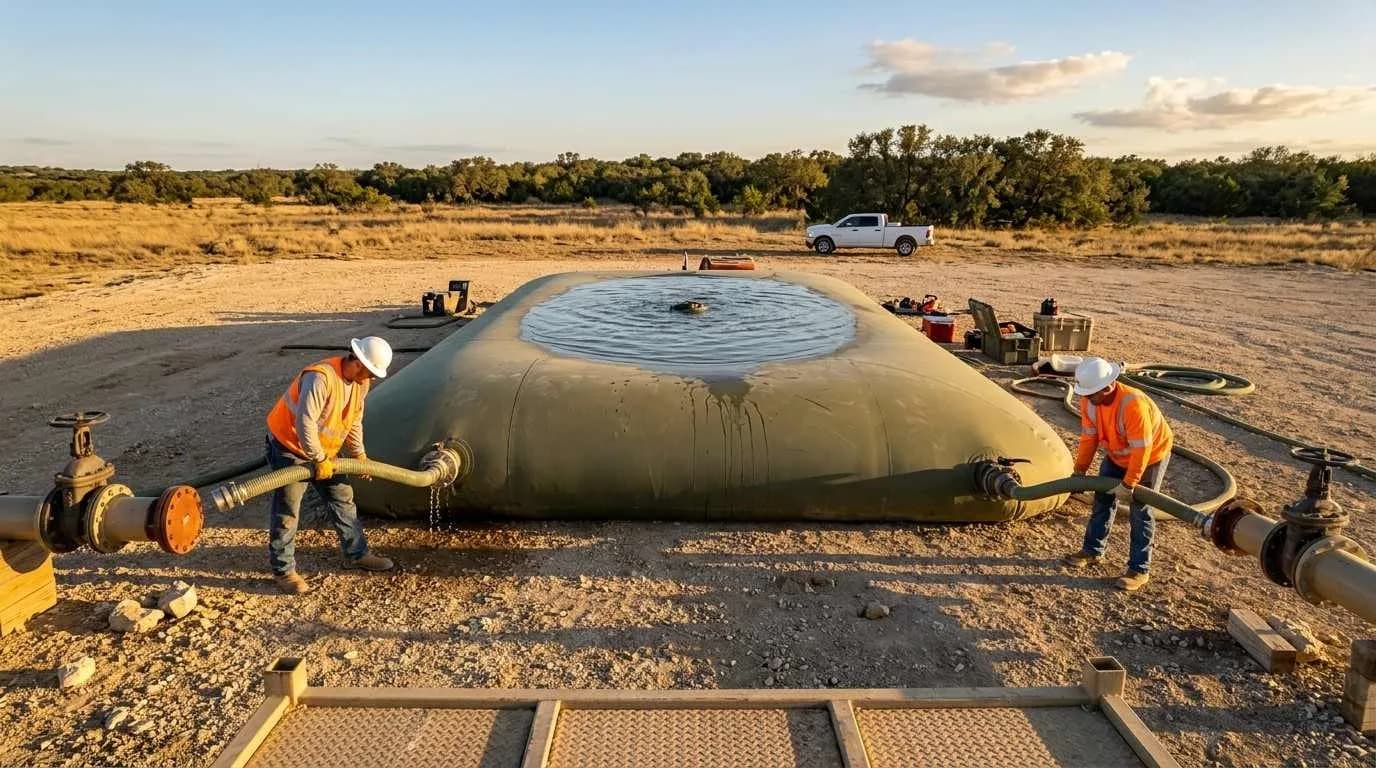
Reuse requires somewhere to put the water between the first test and the next use, whether a portable storage tank on site, a temporary holding pond where site conditions and permitting allow, or a tanker truck if the water needs to be hauled to a different location on a larger site or to a different project entirely. Storage tank sizing needs to account for the actual volume being captured relative to how quickly the next use will draw it down, since a mismatch between storage capacity and testing sequence timing can leave water sitting longer than intended or force an unplanned discharge if storage fills before the next use is ready to receive it.
Hauling logistics add cost and coordination, a tanker truck, a driver, and a receiving location ready for delivery, that needs to be weighed against the cost of simply sourcing fresh water for the next test, meaning reuse via hauling makes the most sense when water costs, discharge restrictions, or water source limitations are significant enough to justify the added logistics.
Pump Setup and Transfer Between Segments
Where reuse involves transferring water directly between adjacent pipe segments rather than through intermediate storage, pump setup needs to handle the transfer without introducing air, contamination, or pressure issues into the receiving segment. This direct transfer approach works best when segments are physically close and testing is sequenced closely enough in time that water doesn’t need extended storage in between, and it requires the same water quality confirmation as any other reuse scenario, since a direct transfer doesn’t change the underlying question of whether the water is appropriate for the next segment’s specific testing requirements.
Cross Contamination Risk Between Uses
Reusing water across multiple pipe segments or multiple activities introduces a cross contamination consideration that a single use discharge approach doesn’t face: does water that has already been used for one purpose carry anything that could compromise the result or acceptability of the next use it’s applied to. This is most relevant when reuse crosses between different stages of the same process, using water from a pressure test for a subsequent disinfection flush, for example, where the water’s prior contact and characteristics need careful evaluation against what the next stage actually requires. Reuse between comparable activities, one pressure test to another pressure test on a similar segment, generally carries lower cross contamination risk than reuse across fundamentally different stages of the testing and disinfection sequence.
Utility Acceptance and Reuse Limitations
Where a new water main’s final acceptance depends on bacteriological testing following a specific disinfection and flushing sequence, reuse of water for that specific disinfection or final flushing stage needs particularly careful evaluation, since a utility accepting the main into service is relying on that testing sequence having been performed with water quality appropriate to produce a reliable bacteriological result. Reuse is generally more appropriate for earlier-stage activities, pressure testing prior to disinfection, or dewatering supporting general construction activities, than for the specific water directly supporting final disinfection and acceptance testing, where introducing reused water of uncertain quality risks compromising the very testing sequence the utility is relying on for acceptance.
When Reuse Is Not Appropriate
Reuse isn’t always the right call. Water carrying contamination from contact with a contaminated soil area, water intended for a use requiring a water quality standard the reused water can’t reliably meet, or a project schedule where storage and transfer logistics would cost more time than they’d save compared to a straightforward discharge, are all scenarios where continuing with a standard discharge approach, properly planned and controlled, makes more practical sense than pursuing reuse. Evaluating reuse as one option among several, discharge, reuse, and hauling to disposal, rather than defaulting to reuse simply because it sounds efficient, keeps the decision grounded in the actual conditions of a specific project rather than a general preference for one approach over another.
Documentation for Reused Water
Where reuse is pursued, documenting what water was reused, its source, its quality characteristics at the time of reuse, and what activity it was applied to, protects the project in the same way discharge documentation protects a project against a later compliance question. This is particularly important where reused water eventually is discharged after its final use, since a reviewer asking about that final discharge event may need to understand the water’s full history, not just its most recent test segment, to evaluate whether the discharge was properly characterized and controlled.
Comparing Reuse, Discharge, and Hauling Together
The most practical approach treats reuse, direct discharge, and hauling to disposal as three options to be compared against a specific project’s water quality, volume, schedule, and site conditions, rather than committing to one approach for an entire project regardless of how conditions shift across different testing phases. A project might reasonably use reuse for early stage pressure testing between adjacent segments, direct discharge with proper controls for a straightforward, well located discharge event, and hauling for an isolated test segment where no practical discharge location exists nearby, all within the same overall testing program.
Frequently Asked Questions
Can we reuse chlorinated disinfection water for pressure testing a different segment?
This depends on whether the receiving segment’s testing requirements are affected by chlorine presence, and generally pressure testing has more tolerance for this than a subsequent disinfection or bacteriological testing stage would, but confirming this against the specific next use’s requirements is necessary before assuming it’s acceptable.
How much storage capacity do we need if we want to reuse water between test segments?
This depends on the volume generated by each test segment and how quickly the next segment will be ready to receive that water, and sizing storage without accounting for potential timing gaps between segments risks either overflow or an unplanned discharge if storage fills before reuse can occur.
Does reusing test water reduce our permitting requirements for eventual discharge?
Reuse can reduce the total volume ultimately requiring discharge, which may keep a project within general permit volume parameters that a fully discharged approach might exceed, but any water eventually discharged after reuse still needs its own proper evaluation and documentation.
Is hauling test water off site always more expensive than discharging it locally?
Not necessarily. Hauling costs need to be weighed against the cost and schedule risk of pursuing individual permit review, addressing a limited discharge location, or resolving a drought related discharge restriction, and in some of these scenarios hauling can be the more practical and ultimately less costly option.
Related Resources
- Volume Thresholds That Trigger a Different Permit Tier: Why a Small Pipeline Test Can Become a Bigger Compliance Issue
- Seasonal Discharge Timing in Texas: How Drought Restrictions and Local Water Rules Change the Plan
- New Water Main Disinfection and Test Water Discharge: How to Coordinate AWWA Standards with TCEQ Rules
- Chlorine Neutralization Before Discharge: The Field Step Contractors Skip Until It Becomes a Compliance Problem
Evaluating Reuse, Discharge, and Hauling Options for an Upcoming Testing Program?
MES helps project teams compare reuse, discharge, hauling, and disposal options for test water based on site conditions, compliance risk, cost, and construction schedule.
We specialize in:
- Water quality evaluation to determine reuse eligibility between test segments and project stages
- Storage tank sizing and transfer logistics planning for multi segment testing programs
- Cross contamination risk assessment between different testing and disinfection stages
- Utility acceptance coordination to protect bacteriological testing integrity where reuse is considered
- Documentation systems tracking reused water’s full history through final discharge
- Comparative cost and schedule analysis across reuse, direct discharge, and hauling options
Modern Engineering Solutions, McKinney, Texas. Contact: (214) 833-6748 or mod-eng.com
Keep reading
More to read.
Talk to an engineer
Tell us about your project.
An engineer reads it
Not a salesperson. Someone who can tell you whether the pathway is real.
You get a first answer
Your options, the agencies involved and the questions that decide cost and schedule.
You decide
No commitment to have the first call.
Prefer the phone? (214) 833-6748