
Blog
Seasonal Discharge Timing in Texas: How Drought Restrictions and Local Water Rules Change the Plan
A discharge plan approved last spring may not work during a summer drought. Learn how seasonal conditions change water source access and discharge approval in Texas.
Quick Answer
A discharge plan that worked perfectly on a project last spring may not work the same way for a similar test scheduled during a summer drought, a heavy rainfall period, or under a different local water authority’s current restrictions. Drought stage restrictions, water source limitations, receiving water conditions, and local water authority rules all shift with the season and with current conditions, and a discharge location, source water, or approval that was acceptable under one set of conditions can require a completely different approach a few months later. Treating a discharge plan as a fixed, one-time decision rather than something that needs to be reconfirmed against current conditions before every testing event is a scheduling risk many project teams don’t recognize until they run into it.
Why a Discharge Plan Isn’t a Fixed, One Time Decision
It’s a natural assumption that once a discharge plan has been evaluated and approved for a project, whether for water source, discharge location, or permitting pathway, that plan remains valid for the duration of the project. In practice, several of the conditions that plan was built around can change meaningfully between the time it was developed and the time an actual test occurs, particularly on a longer project with testing phases spread across different seasons. A discharge plan developed during a normal flow spring can run directly into a drought stage water source restriction or a receiving water quality concern by the time a later test phase occurs in late summer, and the project team needs to recognize this as a real possibility to plan around, not a rare edge case.
Drought Stage Restrictions and Water Source Limitations
Many Texas municipalities and water authorities operate drought contingency plans with defined stages triggered by reservoir levels, groundwater conditions, or other supply indicators, and these stages typically come with specific restrictions on water use, which can directly affect both the water source available for hydrostatic testing and any reuse or supplemental water needs a project has. A water source that was available without restriction during normal conditions may become restricted or require special approval once a drought stage is triggered, and a project team that assumed continued access to that same source without checking current drought stage status can find themselves without an available water source on the date testing was scheduled.
Confirming current drought stage status with the relevant water authority before finalizing a testing schedule, rather than assuming conditions match whatever was true when the project’s original discharge plan was developed, is a simple step that prevents a scheduling surprise tied directly to water availability.
Receiving Water Conditions and Low Flow Sensitivity
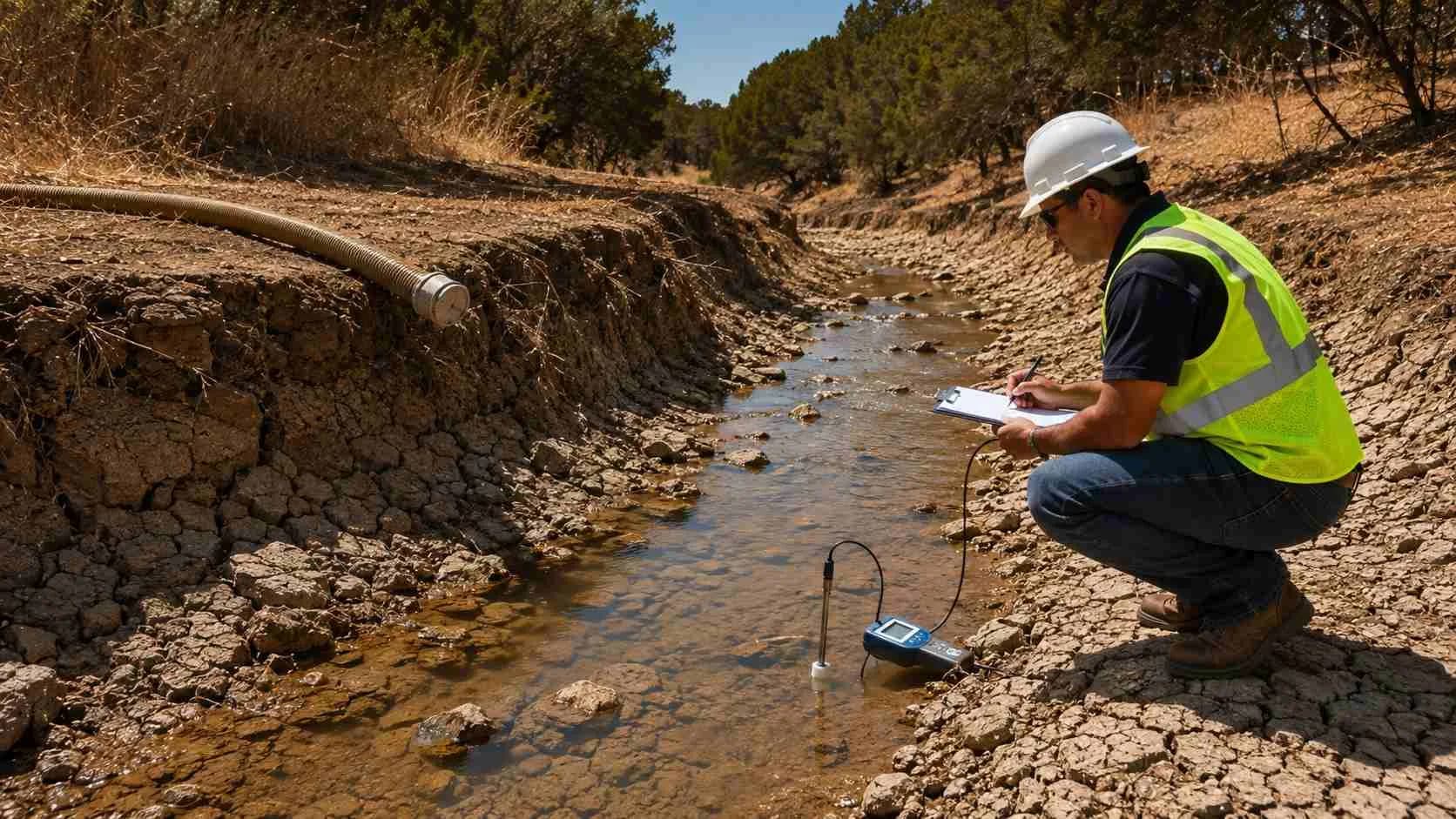
A receiving water’s ability to safely accept a discharge isn’t constant throughout the year. During drought or low flow periods, a creek or stream that normally carries enough flow to dilute a discharge’s residual characteristics may carry significantly less flow, meaning the same discharge that was acceptable under normal flow conditions could create a more concentrated impact, and a higher relative risk to aquatic life or water quality, during a low flow period. This low flow environmental sensitivity means a discharge location and volume evaluated as acceptable during one season should be re evaluated, not assumed to remain acceptable, if testing is scheduled during a period when that same receiving water is running at reduced flow.
Local Water Authority Rules and Discharge Location Changes
Beyond drought stage restrictions tied to water supply, local water authorities and municipalities may have their own seasonal or condition based rules affecting discharge location approval, particularly for discharges into a municipal storm drain or sanitary sewer system. A municipality managing its own system capacity during a heavy rainfall period, when its storm drain system is already carrying significant flow, may treat a request for additional construction discharge into that system differently than during a dry period when the system has more available capacity. Confirming current local water authority rules specific to the discharge location and current conditions, rather than relying on a general understanding of that authority’s typical approach, protects against a discharge location that was previously approved becoming temporarily unavailable or requiring additional coordination under current conditions.
Erosion Risk During Storms Versus Drought Periods
Erosion control planning discussed for hydrostatic test water discharge points needs its own seasonal recalibration, since a discharge point and flow path evaluated as adequately controlled during dry conditions can face a considerably different risk profile if a testing event coincides with or closely follows a significant rainfall period, when ground is already saturated and additional discharge volume compounds an already elevated runoff and erosion risk. Conversely, extended drought conditions can leave ground more compacted or vegetation more stressed in ways that also affect how well a given erosion control measure performs compared to how it was expected to perform when the control was originally designed. Reassessing site and ground conditions immediately before a scheduled discharge, rather than relying on an erosion control plan designed under different seasonal assumptions, catches this kind of mismatch before it becomes a field problem.
Reuse Options and Hauling as Seasonal Alternatives
Where drought restrictions or receiving water conditions make a standard discharge approach temporarily unworkable, evaluating construction water reuse options, using test water for another approved purpose on site rather than discharging it, or hauling water off site to an approved disposal location, can provide a workable alternative that avoids the restricted pathway entirely. Reuse options depend heavily on the water’s actual quality and the specific approved uses available for that water, so this evaluation needs to happen with enough lead time to arrange for reuse infrastructure or hauling logistics rather than being considered only after a standard discharge approach has already been ruled out on short notice.
Contractor Scheduling and Permit Coordination
Because these seasonal factors can shift the available discharge pathway, contractor scheduling for testing events benefits from building in some flexibility around the exact timing, and confirming discharge plan viability against current conditions a reasonable window before the scheduled test date, rather than only at the moment testing begins. Where a permit pathway itself, general permit eligibility discussed for construction discharges generally, is affected by seasonal receiving water conditions or drought related restrictions, permit coordination with TCEQ or the relevant local authority may need to happen further in advance than it would under stable, normal conditions, since any additional review or approval triggered by current conditions adds time to a schedule that a project team may have built assuming standard permit timing applied.
Why This Matters More for Multi Phase Projects
Projects with testing spread across multiple phases and multiple seasons face this risk more directly than a project with a single, short testing window, since a multi phase project is more likely to encounter a meaningful shift in drought stage, receiving water conditions, or local water authority rules between its earlier and later phases. Building a periodic check of current conditions into the overall project schedule, rather than relying on the discharge plan developed at project outset to remain valid throughout, is a practical way to catch a seasonal shift early enough to adjust the plan without disrupting the broader construction schedule.
Frequently Asked Questions
How do we find out the current drought stage for our project area?
This requires checking directly with the relevant municipal water provider or regional water authority, since drought stage status is specific to a given water system’s supply conditions and can change relatively quickly depending on reservoir or groundwater trends in that specific service area.
If our discharge location was approved earlier in the project, do we need to reconfirm it before a later testing phase?
Reconfirming is a reasonable practice for any testing phase occurring meaningfully later than the original approval, particularly if seasonal conditions have shifted, since an approval based on conditions at one point in time doesn’t guarantee that the same conditions, and the same acceptability, apply months later.
Is water reuse always a viable alternative if discharge becomes restricted?
It depends on the water’s quality and whether an approved on site use exists for that specific water, so reuse should be evaluated as one option among several, hauling and disposal being another, rather than assumed to be automatically available without confirming a specific approved use for the water in question.
Does heavy rainfall ever help a discharge plan, or is it only a complication?
Higher receiving water flow during and shortly after rainfall can sometimes provide more dilution capacity for certain discharges, but rainfall also increases erosion risk and can affect storm drain system capacity, so its overall effect on a specific discharge plan depends on the specific location and discharge type rather than being uniformly positive or negative.
Related Resources
- Hydrostatic Testing Records and the TCEQ Audit Trail: What Contractors Need Before an Inspector Shows Up
- Erosion and Sedimentation Control at the Discharge Point: What Inspectors Check When Test Water Hits Open Ground
- TPDES General Permit vs. Individual Permit for Construction Discharges: When the Standard Permit Is Not Enough
- Discharging to a Storm Drain vs. Sanitary Sewer: Why Texas Contractors Get It Wrong on Pipeline and Tank Projects
Planning a Testing Program That Spans Multiple Seasons or Uncertain Conditions?
MES helps project teams evaluate seasonal discharge constraints, coordinate with local water authorities, plan reuse or alternate disposal options, and avoid schedule surprises caused by shifting conditions.
We specialize in:
- Drought stage and water source availability tracking for multi phase testing programs
- Receiving water condition evaluation across seasonal flow variation
- Local water authority coordination for discharge approvals affected by current conditions
- Reuse and hauling alternative planning when standard discharge pathways become restricted
- Erosion control reassessment for site conditions affected by drought or rainfall extremes
- Permit and schedule coordination that builds in seasonal flexibility for long duration projects
Modern Engineering Solutions, McKinney, Texas. Contact: (214) 833-6748 or mod-eng.com
Keep reading
More to read.
Talk to an engineer
Tell us about your project.
An engineer reads it
Not a salesperson. Someone who can tell you whether the pathway is real.
You get a first answer
Your options, the agencies involved and the questions that decide cost and schedule.
You decide
No commitment to have the first call.
Prefer the phone? (214) 833-6748