
Blog
Does Test Water Volume Trigger a Different Permit Tier? What TXG670000 Actually Requires for Pipeline Tests
TXG670000 sets no gallon limit for hydrostatic test water. Learn what decides coverage: vessel type, exclusions, rate control, sampling, and local limits.
Quick Answer
Calling a discharge “small” is a judgment, not a calculation, and it’s the wrong basis for a discharge plan. The Texas hydrostatic test water general permit, TPDES General Permit TXG670000, sets no gallon limit and no volume tier. Coverage depends on what the pipe or tank held before the test, where the water goes, and whether the discharge falls under one of the permit’s exclusions. Volume and rate still matter. The permit requires the discharge rate to be controlled to prevent flooding and erosion, and the city, utility, or drainage owner that receives the water can set its own limits. Put real numbers on volume, rate, duration, and discharge point before the first segment is tested. Relying on instinct is how a routine pipeline test turns into a compliance problem nobody planned for.
As of October 2026: the current TXG670000 took effect April 5, 2025, and expires at midnight on April 5, 2030. Check TCEQ’s TXG670000 page for later changes.
Why “Small” Is a Dangerous Word in Discharge Planning
Every discharge feels small when you’re standing next to the pipe watching it happen. A single test segment discharging over a few hours looks like a modest, temporary event, and it’s easy to extend that same impression to an entire project without recalculating anything, treating the whole testing program as collectively “small” simply because each individual piece felt that way. This is the core mistake: discharge volume needs an actual number, gallons discharged, calculated and totaled, not an impression based on how the discharge looked or felt while it was happening.
The permit does not measure coverage in gallons. It sets conditions instead: control the rate so the discharge does not flood or erode, sample on a fixed schedule where limits apply, and give notice before discharging. Each condition is easier to plan, and to prove, when you know the real volume, rate, and duration. The owner of the ditch, storm drain, or sewer that takes the water will ask for those numbers too.
Calculating Total Volume Across Multiple Test Segments
A pipeline or water main project is rarely tested in a single continuous event. It’s more commonly tested in segments, each segment filled, pressure tested, and discharged before the next segment begins. A project with numerous segments, each individually modest in volume, can add up to a total that looks very different from any single segment. TXG670000 does not use that total to decide coverage, but the total still matters. It sets how long discharges will run, how much the receiving ditch, drain, or sewer must take over the full schedule, how many samples you will collect, and whether hauling or reuse is practical.
Calculating this total requires knowing the number of segments planned, the volume associated with each, and whether segments will discharge to the same location or different locations, since receiving capacity depends on whether volume is concentrated at one point or spread across several. The permit also requires written notice to the TCEQ regional office at least 48 hours before a discharge starts (Part III, Section B.13), so the segment schedule sets your notice dates as well.
Discharge Rate and Duration Alongside Total Volume
Total volume alone doesn’t capture the full picture. Discharge rate, how quickly that volume is released, and duration, how long the discharge event lasts, both affect whether a given discharge exceeds a receiving location’s practical capacity even when total volume alone might seem manageable. A large total volume discharged slowly can be easier for a receiving ditch, storm drain, or sanitary sewer to accommodate than a smaller volume released quickly, since capacity constraints are often tied to instantaneous flow rate as much as to cumulative volume.
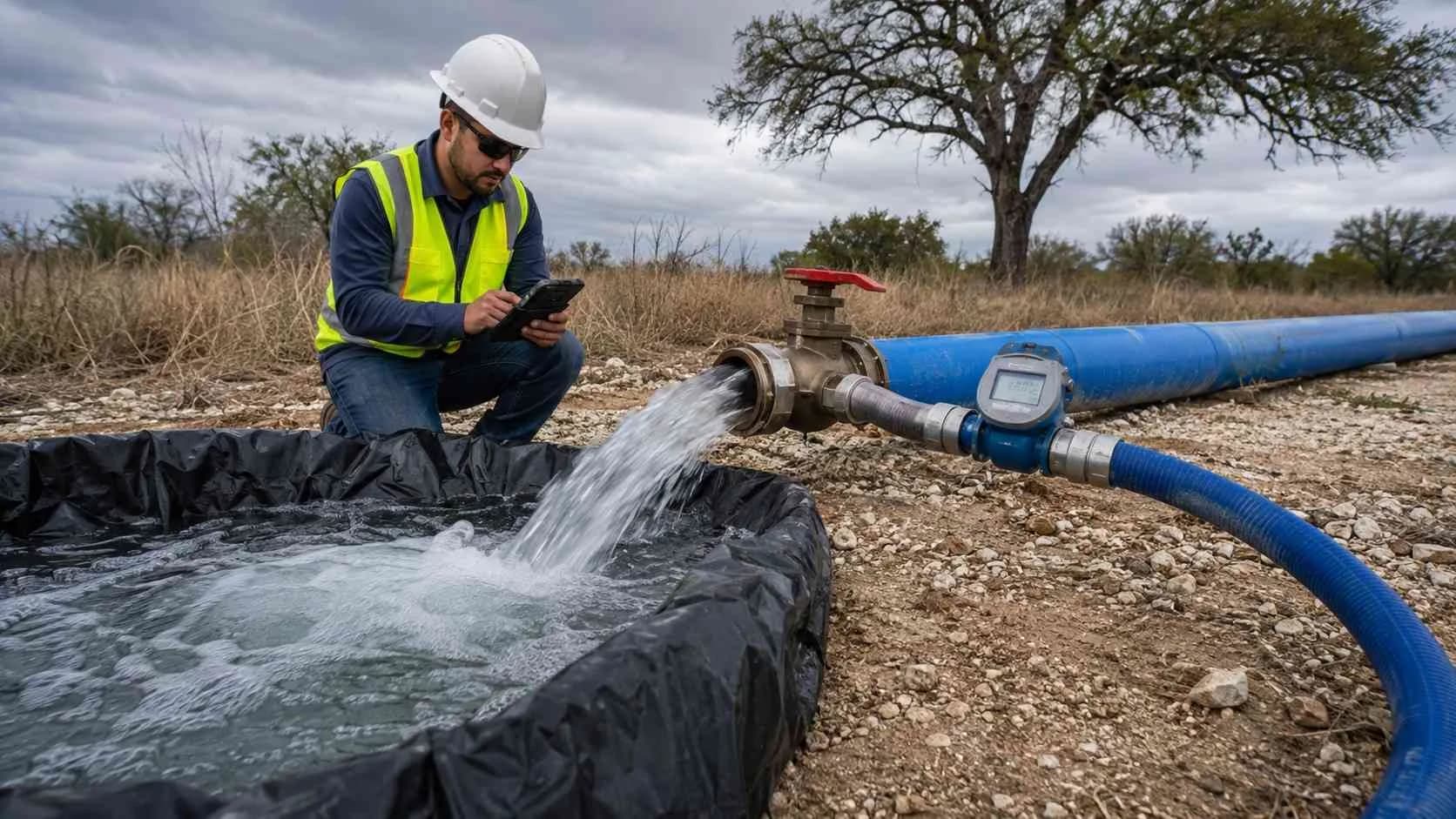
This is where the permit is specific. Part III, Section B.1 of TXG670000 requires the discharge to go to a splash pad, a paved area, or another surface that prevents erosion, and requires the rate of discharge to be controlled through best management practices to prevent flooding and erosion. The permit gives no gallons-per-minute number. What counts is the result on the ground: no flooding and no erosion.
Receiving Ditch or Storm Drain Capacity
A roadside ditch, a storm drain inlet, or another receiving conveyance feature has a practical capacity limit, and a discharge exceeding that capacity, even briefly, can create backup, overflow, or erosion issues independent of whatever water quality characteristics the discharge itself carries. Confirm the actual capacity of the intended receiving conveyance rather than assuming any ditch or drain can take whatever volume and rate a testing program produces.
Two permit conditions apply here. If the discharge starts inside a municipal separate storm sewer system (MS4), the permittee must notify the MS4 operator in writing at least 48 hours before discharging (Part III, Section B.14). And the permit does not give anyone the right to use public or private property along the discharge route (permit cover page). A city, county, or drainage district may have its own rules for its ditches and drains; those are local requirements, separate from TXG670000.
Sanitary Sewer Acceptance and Volume Driven Capacity Concerns
Sending test water to a sanitary sewer is a different path. TCEQ’s fact sheet for TXG670000 lists discharge to a publicly owned treatment works as a disposal method that needs neither this general permit nor an individual wastewater permit (fact sheet, Section III.3). The sewer owner decides whether to take the water and on what terms. Any limit on rate, total volume, time of day, chlorine, or advance approval is a local utility rule, not a TCEQ permit condition.
Those local terms tend to come down to capacity. A sewer segment’s room for a temporary discharge depends on its existing flow at the time. A multi-segment program can be harder on a sewer than one large event, because the sewer has to absorb added flow again and again across an extended schedule. Get the utility’s acceptance terms in writing before the test schedule is fixed.
What Actually Decides Permit Coverage
Texas has covered hydrostatic test water under a general permit since 2005; the old permit by rule for these discharges was repealed in 2007 (TCEQ fact sheet, Section VIII). TXG670000 covers test water from new vessels, existing vessels that held or moved raw or potable water, existing vessels that held only elemental gases, and existing vessels that held petroleum or natural gas substances or related waste (Part II, Section A). Volume is not on the list. The assumption that “it’s just test water, it’ll be covered” runs into trouble for other reasons.
Whether a notice of intent (NOI) is needed also depends on the vessel, not the volume. No NOI is required for new vessels or vessels that held raw water, potable water, or elemental gases, as long as the discharger meets all applicable permit conditions (Part II, Section C.4). Vessels that held petroleum or natural gas substances need an NOI unless the water is land applied under Part III, Section C. Skipping the NOI does not skip the rules: limits, notices, rate control, and records still apply.
Some discharges are not covered at any size (Part II, Section B), including:
- discharges prohibited by the Watershed Protection or Edwards Aquifer rules (30 TAC Chapters 311 and 213)
- new discharges of a pollutant of concern to an impaired water body, or discharges inconsistent with an approved TMDL plan
- discharges that would harm a listed threatened or endangered species or its critical habitat
- test water made from domestic wastewater, reclaimed water, or other industrial wastewater
- pre-test cleaning or rinse water, and material from pigging or pressure washing
- PCBs
Chemicals other than chlorine or tracer dyes may not be added to the vessel (Part III, Section B.5). A discharge that is not eligible needs an individual permit, or coverage under another general permit, before it happens (Part II, Section B.8).
Sampling Requirements Set per Discharge
Sampling under TXG670000 is set per discharge, not by volume. For new vessels and vessels that held raw water, potable water, or elemental gases, the only numeric limit applies when the water has been hyperchlorinated for disinfection: total residual chlorine of 0.10 mg/L daily maximum (Part III, Section A.1). Vessels that held petroleum or natural gas substances have limits for total petroleum hydrocarbons, benzene, total BTEX, pH, and, unless the vessel never held lead, total lead (Part III, Section A.2). In both cases one grab sample is taken in the first hour, and a second sample of the last 10% of the effluent is taken if the discharge lasts more than an hour.
A multi-segment program means more discharges and more samples, but the same rules. A failed vessel retested within 30 days needs no new analyses if the first discharge had no exceedances and no pollutants were added to the vessel (Part III, Section A.3). Keep records for three years (Part IV.9) to show ongoing compliance across the whole program.
How Planning Gaps Change the Schedule
Mid-project stops tend to come from something the plan missed, not from crossing a volume line: a discharge point in an Edwards Aquifer area, where discharge cannot start until Chapter 213 requirements are met (Part II, Section C.3); a vessel that turns out to need an NOI; a missed 48-hour notice; erosion at the outfall; or a sewer utility or MS4 operator that will not take the planned rate. If a discharge turns out not to be eligible, an individual permit is needed before that water can be discharged, and the problem lands after testing has begun. Checking eligibility, notices, and local acceptance during initial planning costs far less.
Comparing Discharge and Reuse Options at Different Volume Scales
Understanding actual projected volume also informs whether reuse options become more attractive at a larger scale, since the reuse and hauling alternatives described for seasonal discharge constraints can become a more practical solution when a project’s cumulative discharge volume is large enough that finding an accepted discharge route for the full volume is genuinely difficult. TCEQ’s fact sheet lists methods that need neither this general permit nor an individual permit, including reuse with no discharge, pumping and hauling to an authorized disposal facility, and discharge to a publicly owned treatment works (fact sheet, Section III.3). Land application is allowed under the permit with conditions, such as no application on saturated ground or within 500 feet of a water well (Part III, Section C). Evaluating discharge and reuse options against actual calculated volume, rather than a general sense of project scale, helps a project team choose the most practical approach before testing begins.
Frequently Asked Questions
How do we calculate cumulative discharge volume across a multi segment pipeline testing program?
Total the volume of each test segment across the whole program, and note which segments discharge to the same point. Compare that total, with planned rate and duration, against what each receiving ditch, drain, or sewer can take and any limits its owner sets. TXG670000 itself has no volume cap.
Is a series of smaller discharges over time treated the same as one large discharge for permitting purposes?
Under TXG670000, neither triggers a different permit tier, because the permit has no volume tier. Each discharge must meet the same conditions, including sampling where limits apply and the 48-hour notice to the TCEQ regional office. A sewer utility or drainage owner may look at the total differently, so ask.
What should we do if our projected volume is more than the receiving system can take?
Address it during project planning, before testing begins. Options include a slower discharge rate, more days, more than one discharge point, or hauling or reusing part of the water. If a discharge may fall outside the general permit, talk to TCEQ early, because an individual permit is a separate application and must be in place before that discharge.
Does discharge rate matter if TXG670000 has no volume limit?
Yes. Part III, Section B.1 requires the rate of discharge to be controlled through best management practices to prevent flooding and erosion. A high rate can also exceed a receiving location’s capacity even when total volume is modest.
Related Resources
- TPDES General Permit vs. Individual Permit for Construction Discharges: When the Standard Permit Is Not Enough
- Discharging to a Storm Drain vs. Sanitary Sewer: Why Texas Contractors Get It Wrong on Pipeline and Tank Projects
- Seasonal Discharge Timing in Texas: How Drought Restrictions and Local Water Rules Change the Plan
- Erosion and Sedimentation Control at the Discharge Point: What Inspectors Check When Test Water Hits Open Ground
Planning a Multi Segment Pipeline or Tank Testing Program?
MES helps project teams estimate discharge volumes and rates, check permit eligibility, compare discharge and reuse options, and prevent last minute permitting problems caused by an unplanned discharge route or rate.
We specialize in:
- Cumulative volume calculation across multi segment pipeline, tank, and force main testing programs
- Discharge rate and duration evaluation alongside total volume for receiving system capacity
- TXG670000 eligibility and exclusion review, and individual permit review where a discharge is not eligible
- Sanitary sewer and storm drain capacity coordination for higher volume testing programs
- Sampling plans that follow the permit’s per-discharge schedule
- Reuse and alternative disposal evaluation for projects where the receiving system cannot take the planned volume or rate
Modern Engineering Solutions, McKinney, Texas. Contact: (214) 833-6748 or mod-eng.com
Keep reading
More to read.
Talk to an engineer
Tell us about your project.
An engineer reads it
Not a salesperson. Someone who can tell you whether the pathway is real.
You get a first answer
Your options, the agencies involved and the questions that decide cost and schedule.
You decide
No commitment to have the first call.
Prefer the phone? (214) 833-6748