
Blog
Hydrostatic Testing on Elevated Storage Tanks vs. Buried Pipelines: Why They Need Different Compliance Plans
Elevated tanks and buried pipelines need their own hydrostatic test discharge plans. See how volume, drawdown rate, and elevation change the actual risk.
Quick Answer
An elevated storage tank and a buried pipeline are both hydrostatically tested with water, but that’s about where the similarity ends. A tank test can generate a huge volume of water released from significant height with a fast drawdown rate, while a pipeline test typically generates smaller, segmented volumes at ground level with a completely different pressure and flow profile. Using the same generic discharge plan for both, or assuming a plan that worked for a water main will work the same way for a ground storage tank or an elevated tank, is a mistake that shows up in the field as an undersized discharge control, an unexpected erosion problem, or a discharge rate the receiving location was never designed to handle. Asset-specific planning, matched to the actual volume, elevation, pressure, and water quality profile of what’s being tested, is what actually prevents this.
Why One Generic Discharge Plan Doesn’t Work Across Asset Types
It’s tempting to treat hydrostatic test water discharge as a single, standardized procedure that applies the same way regardless of what’s being tested, dechlorinate, test, discharge, document. The underlying compliance principles are consistent, but the specific numbers and physical conditions driving those principles vary enormously depending on whether the asset is an elevated storage tank, a ground storage tank, a buried water main, a force main, or a pipeline segment. A discharge plan built around a buried pipeline’s typical volume and flow characteristics can be badly undersized, or entirely mismatched to the discharge elevation and drawdown rate, when applied without modification to an elevated tank test.
Tank Volume and Drawdown Rate
Elevated and ground storage tanks hold considerably more water than a typical pipeline test segment, and the total volume that needs to be discharged once testing is complete reflects that scale directly. Drawdown rate, how quickly the tank is emptied during discharge, is its own separate consideration, since a tank designed to be drawn down relatively quickly for operational reasons can generate a discharge rate far exceeding what a comparable pipeline segment test would ever produce. Planning discharge controls sized for a pipeline segment’s typical volume and rate, and then applying that same plan to a tank test with dramatically higher volume and a faster drawdown rate, is a straightforward way to end up with inadequate erosion control or an overwhelmed receiving location.
Discharge Elevation and Hose Routing
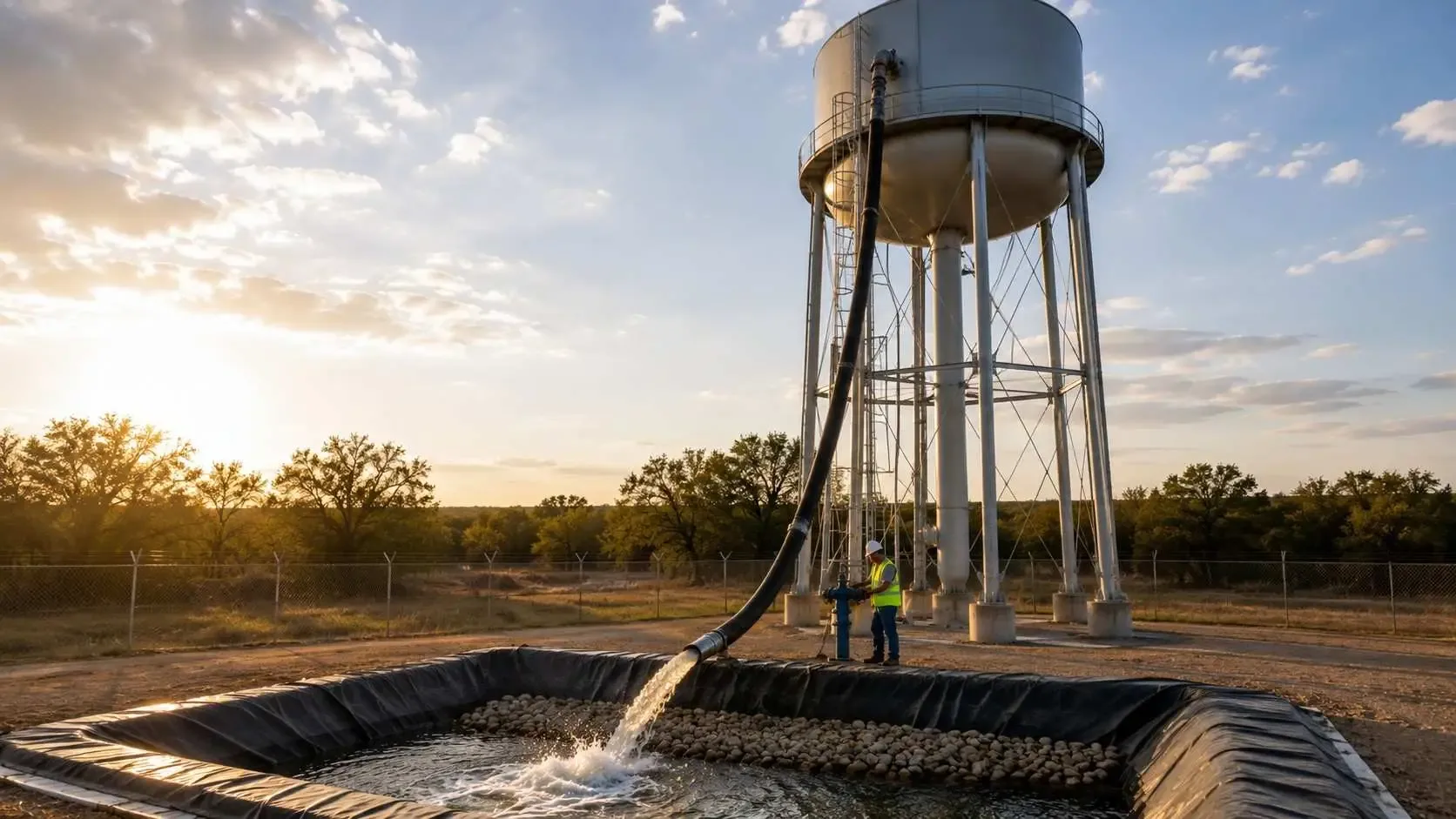
An elevated storage tank discharges from height, and that elevation itself introduces a physical consideration a buried pipeline discharge never has to account for: water falling or flowing from an elevated point carries considerably more velocity and energy by the time it reaches the ground than water released at grade from a pipeline segment. Hose routing from an elevated tank’s discharge point down to grade, and then to the actual discharge location, needs to manage this elevation change without creating an uncontrolled high-velocity release partway through the routing, whether through appropriate hose sizing, routing angle, or an energy dissipation feature integrated into the routing itself, not just at the final discharge point.
Valve Control and Discharge Rate Management
Because tank discharges can involve a faster drawdown and higher potential flow rate than a typical pipeline test, valve control at the discharge point becomes a more active management task, adjusting flow rate throughout the discharge rather than opening a valve fully and letting the tank drain at its own natural rate. A buried pipeline segment, with its smaller volume, often allows more straightforward valve operation without the same need for active rate management throughout the discharge. Recognizing this difference in required valve control approach before discharge begins, rather than treating valve operation as identical regardless of asset type, protects against a discharge rate exceeding what erosion controls or the receiving location were actually designed to handle.
Tank Coating and Sediment Concerns
Storage tanks, particularly older tanks or tanks undergoing rehabilitation, can introduce water quality considerations a buried pipeline test typically doesn’t face: coating material, sediment accumulated on the tank floor over years of service, or residue from tank cleaning or rehabilitation work performed before the hydrostatic test. This sediment and coating related material can end up in the test water and needs its own evaluation separate from the chlorine residual and pH testing standard for any hydrostatic test discharge, since sediment or coating related contaminants carry their own discharge compliance implications independent of chlorine. A pipeline segment test, generally free of this specific concern unless the pipe itself has unusual internal conditions, doesn’t typically require this same additional evaluation, which is exactly why a generic discharge plan built around pipeline testing assumptions can miss a real issue specific to tank testing.
Pipeline Segment Testing, Flushing, and Chlorination
Buried pipeline and water main testing, by contrast, typically involves discrete segments tested individually, each with flushing and chlorination procedures tied to that specific segment’s disinfection and acceptance requirements. This segmented approach means discharge planning for a pipeline project often needs to account for multiple discrete discharge events across the project’s full segment count, the cumulative volume consideration described for volume threshold planning generally, rather than the single, large discharge event a tank test typically represents. A pipeline project’s discharge plan needs to handle this repetitive, segment by segment pattern, while a tank project’s discharge plan needs to handle one or a small number of much larger discharge events instead.
Neutralization Needs Across Asset Types
Chlorine neutralization principles apply to both asset types wherever chlorinated water is involved, but the practical dosing and monitoring approach differs based on volume and discharge rate. A tank discharge, with its larger volume and faster rate, needs dechlorination treatment and verification testing scaled to match that volume and to keep pace with a faster-moving discharge, while a pipeline segment’s smaller, more manageable volume allows a more measured, sequential approach to dosing and verification. Applying a pipeline-scaled dechlorination approach to a tank’s much larger volume risks under-treating the discharge relative to its actual chlorine load.
Storm Drain Capacity and Open Ground Discharge Differences
A receiving storm drain or open ground discharge location evaluated as adequate for a pipeline segment’s typical volume and rate may be entirely inadequate for a tank’s discharge volume and rate, meaning the storm drain capacity and open-ground erosion considerations discussed for discharge point planning generally need to be re evaluated specifically against the actual asset being tested, not assumed to carry over from a different asset type’s previous testing experience at a similar or nearby location.
Field Documentation Differences
Documentation needs differ somewhat by asset type as well. Pipeline testing documentation, discussed in terms of tracking individual segments, needs a structure that clearly organizes records across potentially many discrete segments and discharge events. Tank testing documentation, covering fewer but larger and more consequential discharge events, benefits from more intensive monitoring records within each single event, more frequent sampling intervals given the higher volume and faster rate, and closer attention to drawdown rate and discharge elevation details specific to that tank. Recognizing this difference and structuring documentation accordingly, rather than using an identical documentation template regardless of asset type, produces a more useful and more defensible record for either type of project.
Building an Asset Specific Plan From the Start
The practical solution is treating discharge and compliance planning as something developed specifically for the asset being tested, its actual volume, elevation, pressure profile, and water quality conditions, rather than adapting a plan originally designed for a different asset type and hoping the differences don’t matter. This means a utility, contractor, or developer working across both tank and pipeline projects in a given testing program should expect to develop, or have developed for them, a distinct discharge plan for each asset category involved, rather than a single plan intended to cover everything the project touches.
Frequently Asked Questions
Can we use the same erosion control setup at a discharge point for both a tank test and a pipeline test?
Generally no, since a tank discharge’s higher volume and faster drawdown rate typically require more robust erosion control than a pipeline segment’s smaller, more manageable volume, and sizing erosion control for the larger of the two asset types by default risks under protecting the tank discharge specifically.
Does an elevated tank discharge need different dechlorination treatment than a ground storage tank?
The underlying dechlorination principle is the same, but an elevated tank’s discharge elevation adds a hose routing and energy management consideration a ground storage tank doesn’t face to the same degree, meaning both need dechlorination scaled to volume, but the elevated tank also needs additional planning around how the water reaches grade safely.
Why would sediment or coating material be a concern for a tank but not typically for a pipeline?
Storage tanks accumulate sediment and coating related material over years of service in a way that new or recently installed pipeline segments generally don’t, making tank floor sediment and coating condition evaluation a tank specific step that doesn’t have a direct equivalent in typical new pipeline testing.
If our project includes both tank and pipeline testing, do we need two entirely separate discharge plans?
Generally yes, developed specifically around each asset type’s actual volume, elevation, and water quality profile, since a single generic plan risks being poorly matched to at least one of the two asset types even if it happens to work reasonably well for the other.
Related Resources
- Volume Thresholds That Trigger a Different Permit Tier: Why a Small Pipeline Test Can Become a Bigger Compliance Issue
- Erosion and Sedimentation Control at the Discharge Point: What Inspectors Check When Test Water Hits Open Ground
- New Water Main Disinfection and Test Water Discharge: How to Coordinate AWWA Standards with TCEQ Rules
- Chlorine Neutralization Before Discharge: The Field Step Contractors Skip Until It Becomes a Compliance Problem
Planning Testing and Discharge for Tanks, Pipelines, or Both on the Same Project?
MES helps utilities, contractors, and developers create asset specific testing and discharge plans that match the infrastructure being tested instead of relying on one generic approach.
We specialize in:
- Volume, drawdown rate, and discharge elevation analysis for elevated and ground storage tank testing
- Segment by segment discharge planning for buried pipelines, water mains, and force mains
- Tank specific evaluation of coating, sediment, and rehabilitation related water quality concerns
- Dechlorination and erosion control sizing matched to each asset type’s actual volume and rate
- Storm drain and open ground discharge capacity evaluation specific to the asset being tested
- Documentation systems structured differently for high frequency segment testing versus large single event tank discharges
Modern Engineering Solutions, McKinney, Texas. Contact: (214) 833-6748 or mod-eng.com
Keep reading
More to read.
Talk to an engineer
Tell us about your project.
An engineer reads it
Not a salesperson. Someone who can tell you whether the pathway is real.
You get a first answer
Your options, the agencies involved and the questions that decide cost and schedule.
You decide
No commitment to have the first call.
Prefer the phone? (214) 833-6748