
Blog
Self-Monitoring and Reporting Requirements for Texas Significant Industrial Users
A facility can meet every discharge limit and still get cited. See why self monitoring and reporting causes more SIU violations than the wastewater itself.
Quick Answer
A Significant Industrial User in Texas is required to monitor and report its wastewater discharge because the local POTW has no other way to confirm, on an ongoing basis, that the facility isn’t causing interference, pass-through, or a violation of local discharge limits. Self-monitoring typically includes sampling at an approved location, using grab or composite samples depending on the parameter, tracking flow, pH, BOD, TSS, COD, metals, FOG, ammonia, and any facility-specific local limit parameters, and submitting the results through periodic compliance reports, sometimes preceded by a baseline monitoring report, each backed by a certification statement, chain of custody documentation, and certified laboratory results. The hidden risk for most SIUs isn’t the pretreatment equipment itself. It’s the sampling, reporting, and recordkeeping process around that equipment, since a facility can be fully compliant on discharge quality and still face enforcement for incomplete data, missed deadlines, or a monitoring point that doesn’t meet the POTW’s requirements.
Why the POTW Needs This Data, Not Just Your Word
A control authority approving an SIU’s discharge permit is making an ongoing judgment call: that this facility’s wastewater won’t interfere with treatment plant operations, won’t pass pollutants through untreated, and won’t create a slug discharge or local limit violation. That judgment can’t be made once at permit issuance and left alone, because a facility’s process, its chemical use, and its operating conditions all change over time in ways the city has no direct visibility into.
Self monitoring is the mechanism that gives the city ongoing visibility without requiring constant on site presence. Regular sampling and reporting confirm, discharge by discharge, that a facility’s pH stays in range, that its organic and solids loading stays within permit limits, that metals and toxic pollutants stay below thresholds that would cause interference or pass through, and that nothing about the discharge suggests a slug event is developing. Without that data, the city is relying entirely on the facility’s word that everything is fine, and no pretreatment program is built to operate that way.
What Self Monitoring Actually Involves
The specific monitoring and reporting obligations vary by permit, but most Texas SIUs are working with some combination of the same core elements.
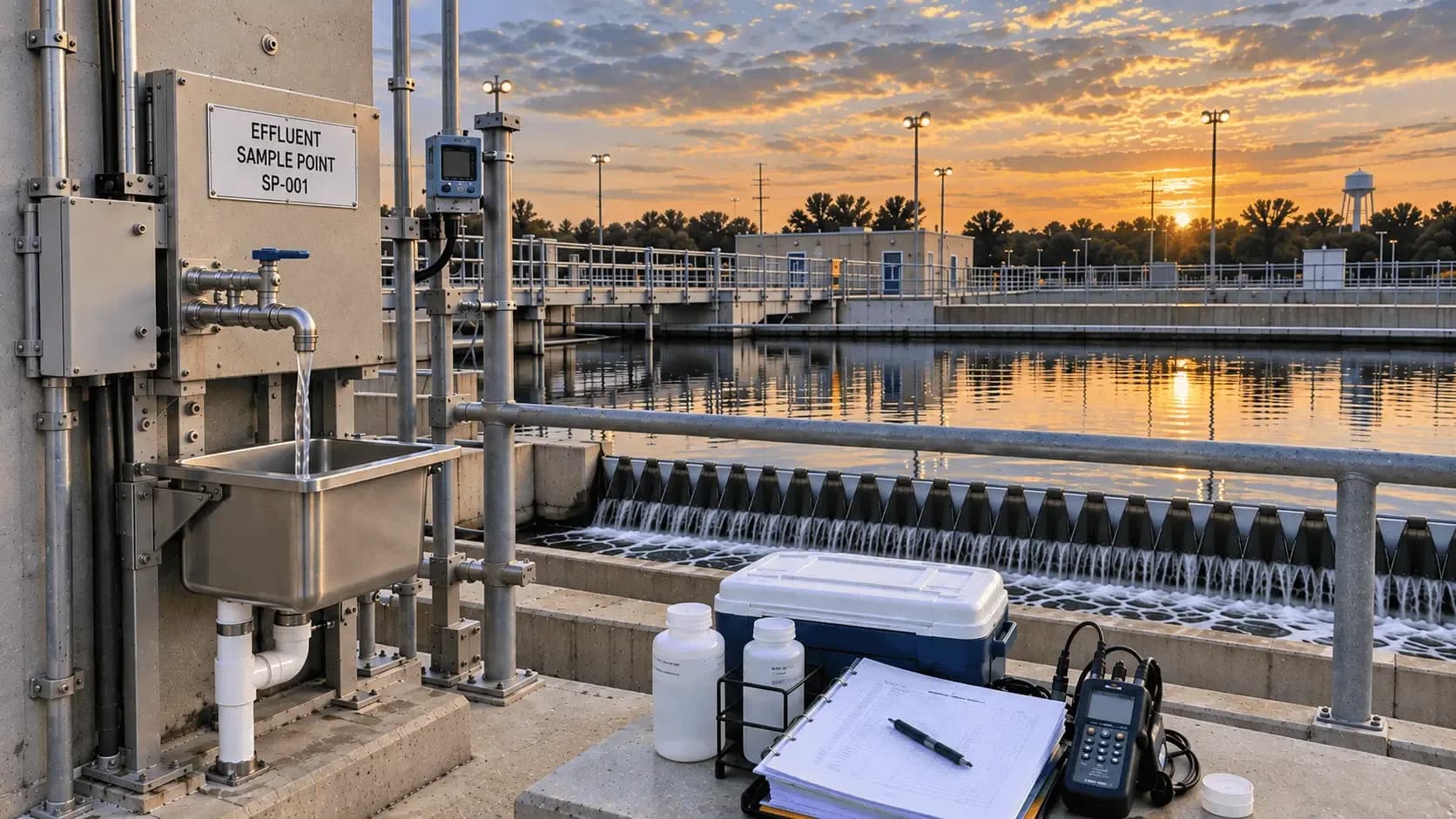
Approved sampling locations are set in the permit and typically require a dedicated point, often a sampling manhole, positioned to capture a representative sample of the facility’s actual discharge before it mixes with other flows. Sampling from the wrong location, even with good intentions, can produce data the city won’t accept.
Grab samples capture a single point in time snapshot and are typically used for parameters like pH that can change quickly and where an instantaneous reading is meaningful. Composite samples, collected over a period of time and combined, are more appropriate for parameters where an average concentration over the discharge period matters more than any single moment, such as BOD or COD. Flow measurement ties directly into loading calculations, since a permit’s pollutant limits are often expressed as a mass, meaning concentration alone doesn’t tell the whole compliance story without an accurate flow number behind it.
The parameters themselves cover the ground you’d expect: pH monitoring, BOD, TSS, COD, metals, FOG, and ammonia are common across a wide range of industrial permits, and beyond these, most permits also specify local limit parameters particular to that POTW’s own treatment process and receiving stream permit, which won’t necessarily match what a facility’s peers in a different city are required to monitor.
Chain of custody documentation tracks a sample from collection through laboratory analysis, establishing that the result reported actually reflects the sample taken and wasn’t compromised in transit. Certified laboratory reports come from a lab meeting the state’s certification requirements for the specific analyses performed, and using an uncertified lab, even inadvertently, can invalidate otherwise accurate results. Calibration records for on site monitoring equipment, flow meters, pH probes, and samplers, demonstrate that the readings those instruments produced were actually reliable at the time they were taken. Inspection records document the POTW’s own site visits and findings, which a facility should retain and cross-reference against its own data.
Periodic compliance reports are the recurring submission most SIUs are on the hook for, typically summarizing sampling results, flow data, and any exceedances over the reporting period, and baseline monitoring reports apply to Categorical Industrial Users establishing their initial compliance status when first classified. Every report of this kind is generally accompanied by a certification statement, a signed attestation, often required from a specific responsible official, confirming the accuracy of the data submitted, which means the person signing is putting their name behind numbers they need to actually trust.
The Compliance Risk Nobody Budgets For
Here’s the pattern that catches experienced facility operators off guard: a facility installs the right pretreatment equipment, operates it correctly, and genuinely discharges wastewater within its permit limits, then still ends up cited for a violation. The cause is almost never the discharge itself. It’s a missed reporting deadline, a sample collected from a location that doesn’t match the permit’s specified point, a laboratory that wasn’t properly certified for the parameter tested, a calibration record that doesn’t exist when the city asks for it, or a certification statement submitted without the required signature.
A control authority evaluating compliance doesn’t distinguish between “the wastewater was actually fine but the paperwork was wrong” and “the wastewater was out of compliance.” Both look identical from the city’s side of the file: incomplete or inaccurate data it can’t verify or use. This is why self monitoring and reporting deserves the same engineering attention as the pretreatment system itself, because a facility that treats monitoring as an administrative afterthought is carrying real enforcement risk regardless of how well its treatment equipment actually performs.
Designing a Monitoring Program That Actually Holds Up
The facilities that avoid this trap generally built their monitoring program with the same engineering discipline they applied to their pretreatment system, rather than assembling it after the fact from whatever equipment happened to be convenient.
Sampling manholes designed and located correctly from the start give a facility a monitoring point that satisfies the permit’s requirements and remains physically accessible for both the facility’s own sampling and the city’s inspections. Automated samplers reduce the labor and human-error risk of manual composite sampling, particularly valuable for facilities with variable operating hours or limited environmental staff. Flow meters tied into that same monitoring point give accurate, continuous data rather than periodic estimates, which matters directly for any permit limit expressed as mass loading.
Equalization tanks and pH control systems, beyond their role in managing discharge quality itself, also make monitoring data more consistent and more representative, since a facility discharging steady, controlled flow produces sampling results that are easier to interpret and less prone to the kind of spike that triggers a false exceedance. Properly designed monitoring points, meaning access, safety, and sample representativeness all considered together, reduce the chance that a technically correct sample still gets challenged on procedural grounds.
Equipment maintenance logs for samplers, flow meters, and any on site monitoring instrumentation create the calibration and service history a facility needs on hand when the city or a report deadline asks for it. Operator training ensures the people actually collecting samples and running equipment understand why the procedure matters, not just the mechanical steps. And a compliance calendar, tracking every report deadline, sampling event, and certification due date against the facility’s actual permit terms, is often the single cheapest control a facility can put in place, and the one most likely to prevent a violation that has nothing to do with the wastewater itself.
Frequently Asked Questions
What self monitoring does a Texas Significant Industrial User usually have to perform?
Most Texas SIUs sample their discharge at an approved location on a schedule the permit sets, tracking parameters like pH, BOD, TSS, COD, metals, FOG, and ammonia along with flow, then submit those results through periodic compliance reports backed by certified lab results and a signed certification statement. The exact parameters and frequency depend on the specific permit and the local limits that POTW has established.
Who is responsible for collecting samples and submitting reports?
The facility itself is responsible, typically through its environmental manager or a designated responsible official who also signs the certification statement submitted with each report. Some facilities handle sampling with in-house staff, and others contract it to a third party, but the compliance responsibility and the certification liability stay with the facility regardless of who physically collects the sample.
What happens if an SIU misses a report or submits incomplete data?
A missed report or incomplete data submission is generally treated as a permit violation by the control authority, separate from whether the underlying discharge itself was in compliance. This can trigger a notice of violation, increased inspection frequency, and in repeated or serious cases, formal enforcement action, even when the facility’s actual wastewater never exceeded a discharge limit.
How can engineering design make self monitoring easier and more reliable?
A properly located sampling manhole, an automated sampler, and a flow meter tied into that same monitoring point remove a lot of the manual error risk from day to day sampling. Equalization and pH control also make discharge more consistent, which produces monitoring data that’s easier to interpret and less likely to trigger a false exceedance from an isolated spike.
What should a facility prepare before a POTW inspection?
Have sampling and lab results, calibration records for any on site monitoring equipment, maintenance logs, and prior compliance reports organized and ready to show. An inspector is checking whether the facility’s actual monitoring practice matches its permit and its own reported data, so the documentation needs to be complete and consistent, not just technically present somewhere in a file.
Related Resources
- Texas Wastewater Pretreatment Permits: What Industrial Facilities Discharging to a POTW Must Know
- How TCEQ Sets Effluent Limits: Understanding Receiving Water Quality Standards and Permit Conditions
- Why Your Site Civil Engineer Isn’t the Right Person to Lead TCEQ Permitting
- Land Application Permits in Texas: A Faster Path to Wastewater Approval for Developers
Don’t Let Your Monitoring Program Become the Enforcement Problem
A facility can have the right pretreatment equipment and still end up cited for a violation caused entirely by sampling, reporting, or recordkeeping gaps. Before that gap turns into an enforcement letter, MES helps Texas SIUs design monitoring points that hold up under inspection, build sampling and reporting programs that actually match permit requirements, and coordinate directly with POTW pretreatment staff to keep a facility’s compliance record clean.
We specialize in:
- SIU monitoring point design, including sampling manholes and flow meter placement
- Sampling and reporting program design matched to specific permit requirements
- Automated sampler and flow monitoring system specification
- Equalization and pH control system design to stabilize discharge quality
- Compliance calendar and recordkeeping system setup for ongoing reporting
- Direct POTW coordination for permit interpretation and inspection preparation
Modern Engineering Solutions, McKinney, Texas. Contact: (214) 833-6748 or mod-eng.com
Keep reading
More to read.
Talk to an engineer
Tell us about your project.
An engineer reads it
Not a salesperson. Someone who can tell you whether the pathway is real.
You get a first answer
Your options, the agencies involved and the questions that decide cost and schedule.
You decide
No commitment to have the first call.
Prefer the phone? (214) 833-6748